Description
Almost every listing sells this as a body lotion for bumpy arms. What almost none of them mention is that the CeraVe SA Lotion is not a cosmetic at all — it is a registered over-the-counter medicine, with a declared active ingredient, an approved medical indication, and a set of label warnings CeraVe’s own marketing page never shows you.
This page prints those warnings, gives you the salicylic acid percentage the brand’s consumer site leaves out, and settles the single most common confusion around this product: the CeraVe SA Lotion and the CeraVe SA Smoothing Cream are not the same formula.
Table of Contents
- Product Overview
- It Is a Registered Drug, Not a Cosmetic
- The 3% Salicylic Acid, and Where That Number Comes From
- SA Lotion vs SA Smoothing Cream
- Key Benefits
- Key Ingredients
- Four Things We Will Not Claim
- The Label Contradiction Worth Knowing
- Who Should Use It
- Suitable Skin Types
- How to Use the CeraVe SA Lotion
- How Often
- The Sunburn Alert
- Where It Fits in Your Routine
- What to Combine It With
- Do Not Combine With
- Realistic Results
- Size and Value
- Authenticity and Storage
- Full Ingredient List
- Warnings and Precautions
- Product Specifications
- Frequently Asked Questions
- Should You Buy It?
Product Overview
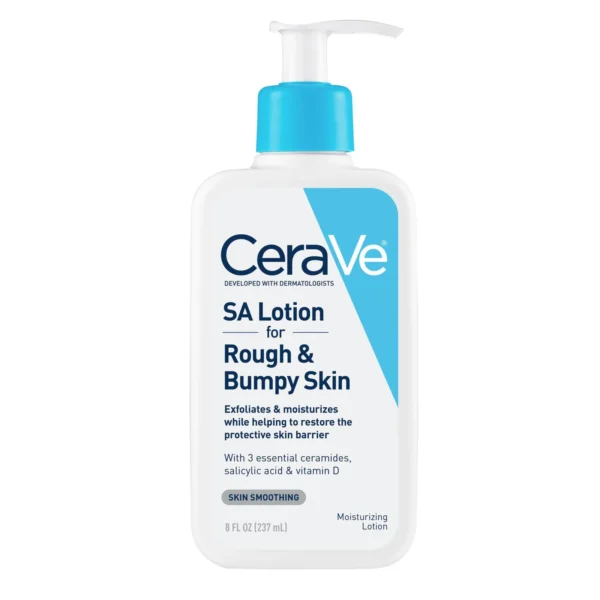
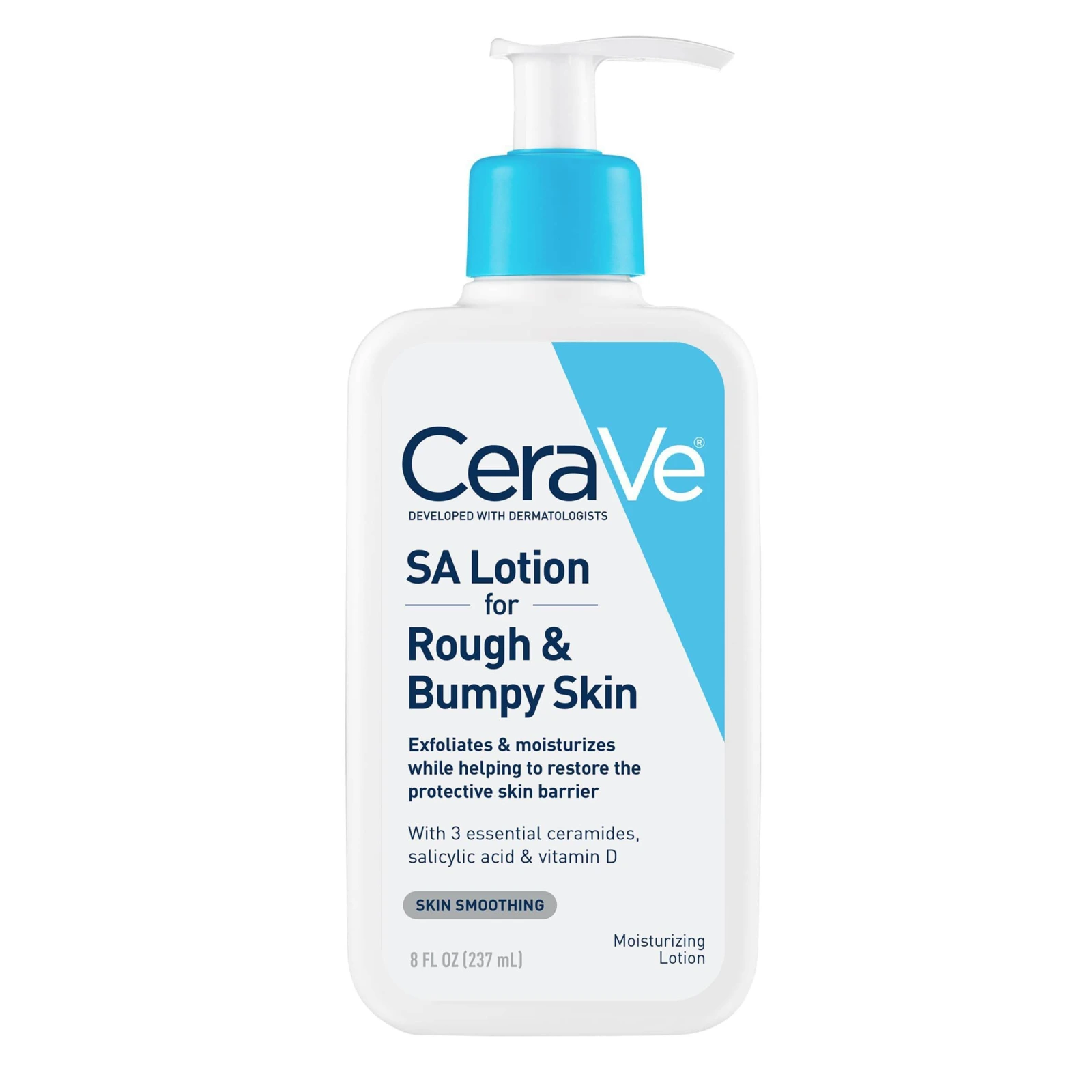
CeraVe was built by dermatologists around one idea: put back the three ceramides that damaged skin has lost. The CeraVe SA Lotion takes that base and adds two acids to it — salicylic acid to loosen the plug inside a blocked follicle, and ammonium lactate to hold water in the skin around it.
The result is aimed at what CeraVe calls “rough and bumpy skin”: the sandpaper texture on upper arms, thighs and shoulders that most people know as keratosis pilaris. It is a leave-on body product in a 237 ml pump bottle, and 237 ml is the only size the CeraVe SA Lotion is made in.
What makes this product unusual is not the formula. It is the paperwork. In both the United States and Canada, the CeraVe SA Lotion is registered as an over-the-counter drug rather than a cosmetic — which means it carries a declared active ingredient at a declared strength, an approved medical use, and mandatory warnings. Almost none of that appears on CeraVe’s consumer website. All of it appears below.
It Is a Registered Drug, Not a Cosmetic
The CeraVe SA Lotion is listed in the United States FDA drug label database under its original retail name, Renewing SA Lotion, with L’Oréal USA Products Inc as the labeller and a national drug code assigned to the 237 ml bottle. Canada reaches the same conclusion from the other direction: CeraVe Canada lists salicylic acid as a medicinal ingredient, not a cosmetic one.
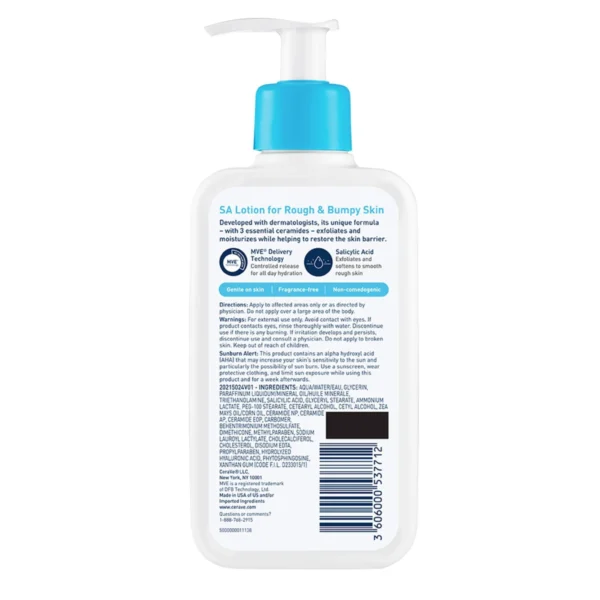
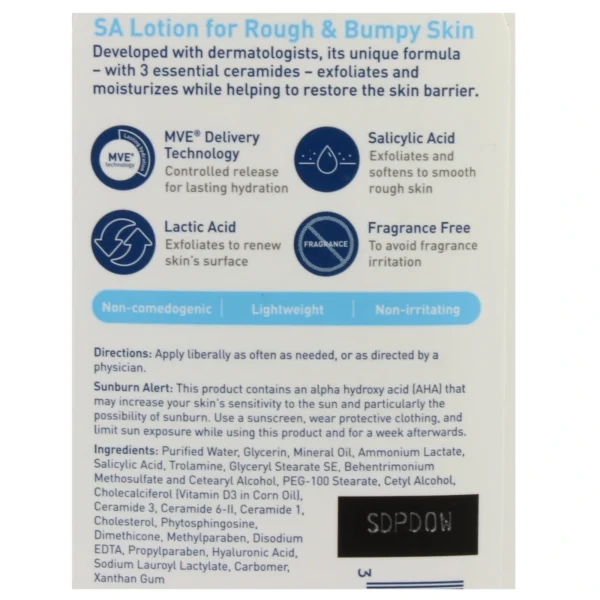
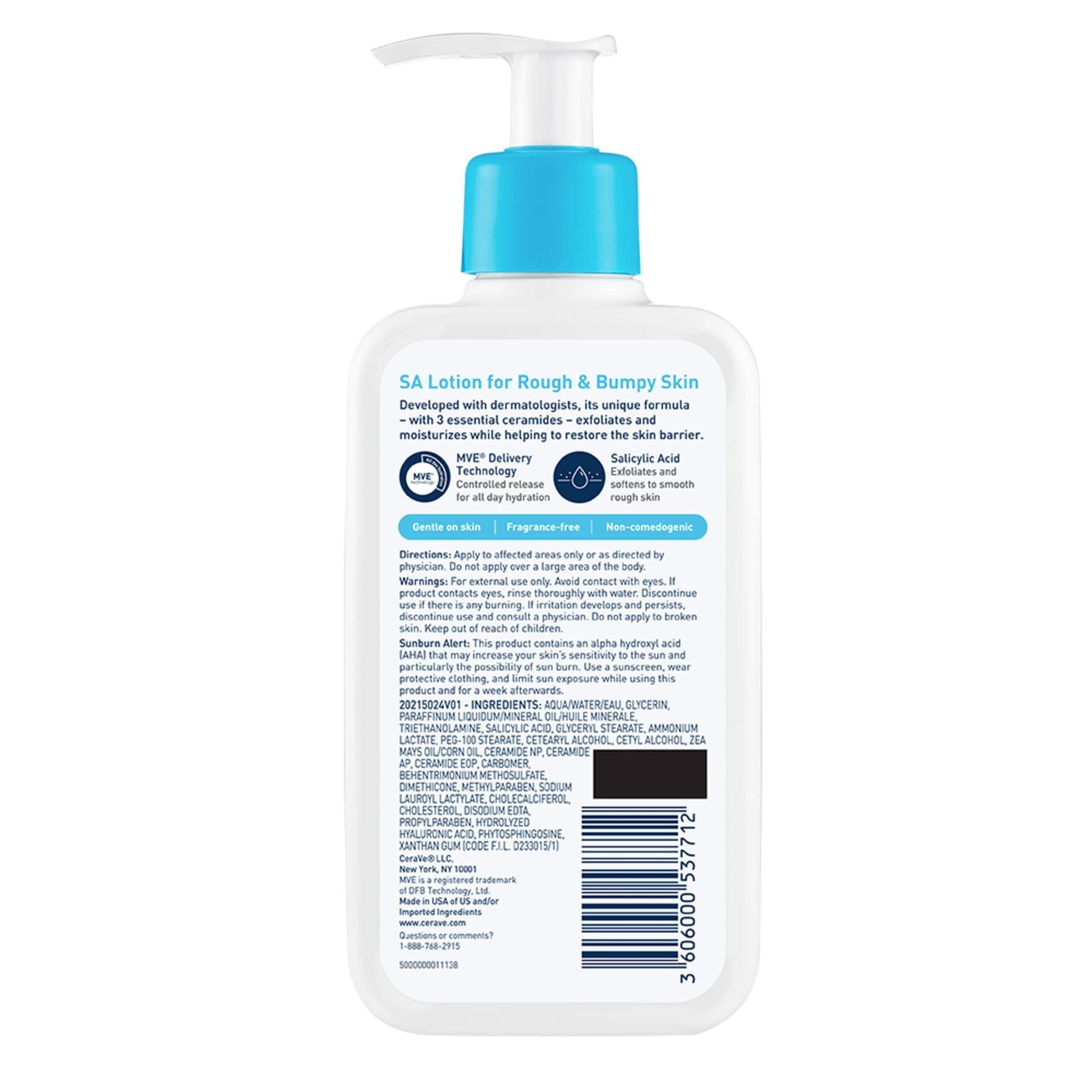
One caveat we only know because we looked at the pack itself: the retail bottle carries no Drug Facts panel and prints no percentage anywhere. Its back label is laid out like a cosmetic — Directions, Warnings, Sunburn Alert, Ingredients — with no active-ingredient declaration at all. So the 3% is real and officially published, but you cannot read it off the bottle in your hand. You have to go to the regulatory record or CeraVe’s Canadian site, which is exactly where a shopper never goes.
Both sources are public, so you do not have to take our word for it: the US FDA drug label carries the 3% active-ingredient declaration and the approved indication, and CeraVe’s own product page carries neither.
That classification carries a specific approved use, and it is not the one on the front of the bottle. The registered indication reads: helps to prevent and reduce the recurrence of itchy, red and flaking skin associated with seborrheic dermatitis and/or psoriasis.
Keratosis pilaris is not the approved indication. It is what the CeraVe SA Lotion is marketed for, bought for, and by a great many accounts works for. But the regulator approved it for something else, and the brand does not tell you that. We would rather you knew, because it changes how you should read the warnings further down: those are drug warnings written to a legal standard, not marketing softeners.
None of this makes the CeraVe SA Lotion unsafe or a poor buy. It makes it a stronger product than its packaging suggests, with a real active and real label restrictions attached.
The 3% Salicylic Acid, and Where That Number Comes From
The CeraVe SA Lotion contains salicylic acid at 3%. That is not our estimate and not a blogger’s guess — it is the declared active ingredient strength on the FDA drug label, and CeraVe Canada publishes the same figure as the medicinal ingredient.
Here is the odd part: CeraVe’s own consumer product page publishes no percentage at all and shows no drug facts panel. The number exists in the regulatory record and on the Canadian site, and nowhere a normal shopper would look. Most Bangladeshi listings for the CeraVe SA Lotion therefore quote nothing, or quote a number somebody invented.
For context, 3% is meaningfully above the 2% most over-the-counter salicylic acid products sit at, and this is a leave-on lotion rather than a rinse-off wash — so contact time is hours, not seconds. That combination is why the CeraVe SA Lotion works on body texture that gentler products do not touch, and equally why the label tells you not to spread it everywhere.
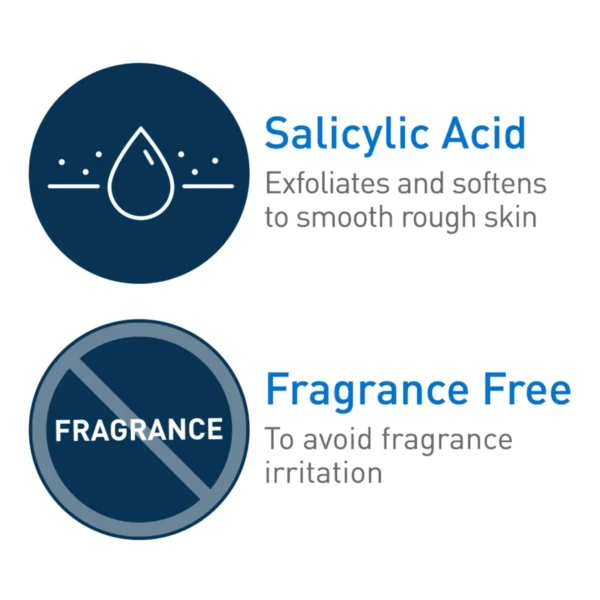
The second acid is ammonium lactate, seventh in the ingredient list. It is the salt form of lactic acid, an alpha hydroxy acid, and it is both an exfoliant and a humectant. CeraVe does not publish its percentage in any market, so neither will we. It matters for one reason: it is the ingredient that triggers the sunburn alert.
SA Lotion vs SA Smoothing Cream
This is the confusion that costs people money, and it is easy to settle because both formulas are published.
The CeraVe SA Lotion is the American and Canadian product. The CeraVe SA Smoothing Cream is the British, European, Australian and Middle Eastern one. They are sold under near-identical marketing, for the same concern, in similar packaging — and they are not the same formula.
| SA Lotion (this product) | SA Smoothing Cream | |
|---|---|---|
| Markets | US, Canada | UK, EU, Australia, Egypt |
| Urea | None | 10%, second ingredient |
| Ammonium lactate | Present | Absent |
| Niacinamide | None | Present |
| Mineral oil | Present | Absent |
| Vitamin D | Present (cholecalciferol) | Absent |
| Preservative | Methylparaben, propylparaben | Phenoxyethanol |
| Status | OTC drug | Cosmetic |
| Sizes | 237 ml only | 177 ml tube, 340 g pot |
They diverge at the second ingredient and never reconcile. CeraVe has never acknowledged that these are different products, never explained why, and never said which one it considers better. If you have read a review praising the 10% urea, that reviewer was holding the cream, not the CeraVe SA Lotion.
One consequence worth stating: the CeraVe SA Lotion contains no niacinamide. A large number of retailer listings claim it does. They are copying the SA Cream’s ingredient list, or the Smoothing Cream’s. Read the panel on your own bottle.
Key Benefits
What the CeraVe SA Lotion is genuinely good at:
- A real 3% active. Declared, regulated, and higher than the 2% most shelf products carry.
- Two acids with different jobs. Salicylic acid is oil-soluble and works inside the follicle; ammonium lactate works on the surface and holds water.
- Three ceramides plus cholesterol and phytosphingosine. This is what separates the CeraVe SA Lotion from a plain acid lotion — barrier lipids go back in as the acids come through.
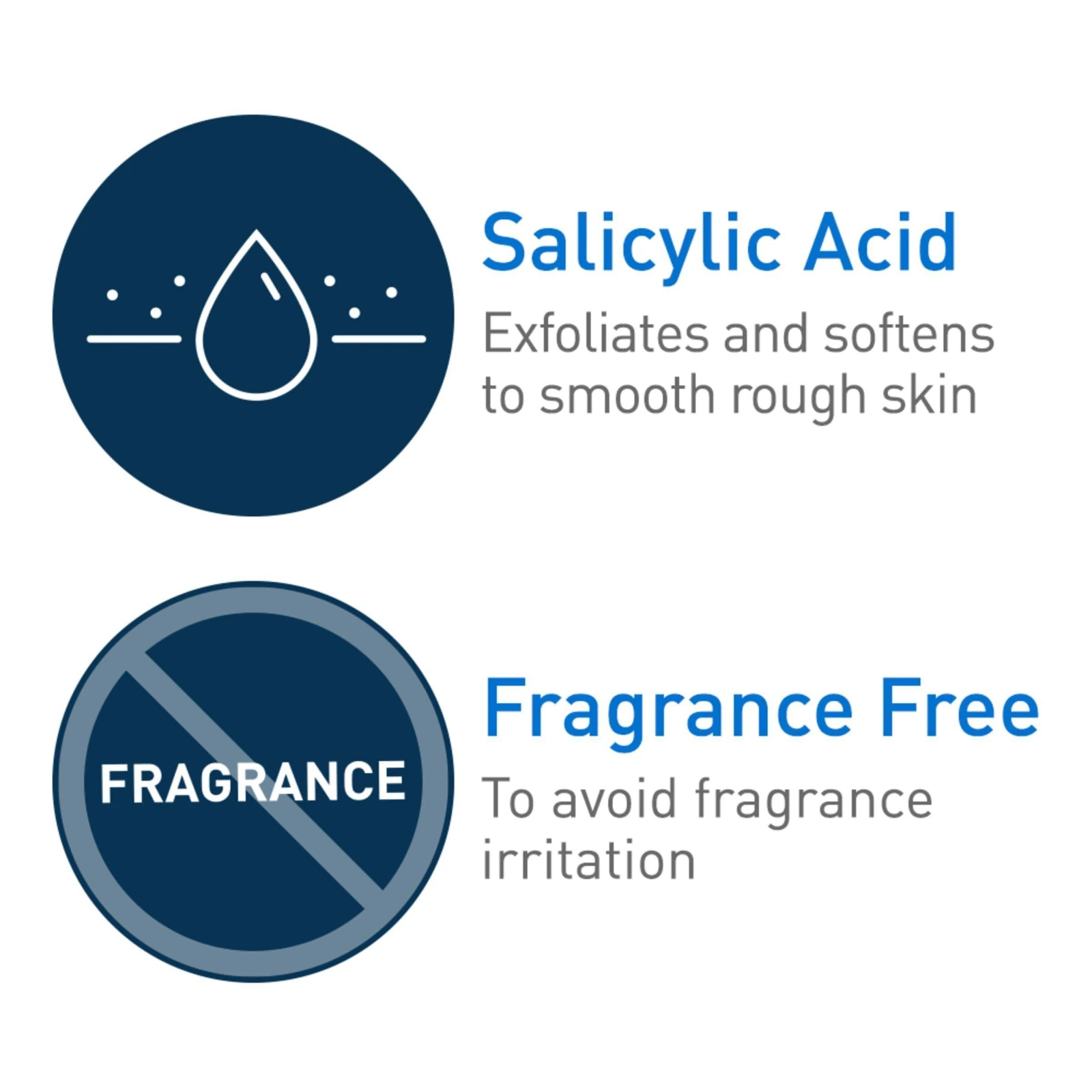
- Fragrance-free, verified. No parfum or fragrance anywhere in the ingredient list.
- Pump bottle. Easier to dose on arms and legs than a tub, and more hygienic.
- Light enough to layer. It is a lotion, not a balm; it absorbs without leaving arms tacky under clothing.
Key Ingredients
Reading the CeraVe SA Lotion label from the top, in the order it is printed:
- Salicylic acid — fifth in the list, declared at 3%. The beta hydroxy acid doing the work inside blocked follicles.
- Ammonium lactate — seventh. Alpha hydroxy acid plus humectant. Also the reason for the sun warning.
- Glycerin — second. Draws and holds water.
- Ceramide NP, Ceramide AP, Ceramide EOP — the CeraVe signature trio, positions twelve to fourteen, supported by cholesterol and phytosphingosine. Together these are the lipids skin uses to rebuild its own barrier.
- Paraffinum liquidum (mineral oil) — third, so a major component. An occlusive that seals water in: inert and well tolerated, but worth knowing about if you deliberately avoid it.
- Cholecalciferol (vitamin D) — an unusual inclusion for a body lotion, and one CeraVe does not explain.
- Hydrolyzed hyaluronic acid — twenty-fourth, near the tail of the list. Present, but do not buy the CeraVe SA Lotion as a hyaluronic acid product.
- MVE Delivery Technology — CeraVe’s own multivesicular emulsion system, printed on the pack as “controlled release for all day hydration”. It is a delivery format rather than an ingredient, and MVE is a registered trademark of DFB Technology.
- Methylparaben and propylparaben — the preservative system. Stated plainly because a lot of shoppers filter on it.
Four Things We Will Not Claim
All four are checkable, and all four appear on other listings for the CeraVe SA Lotion.
1. We will not say it contains niacinamide. It does not. That belongs to the SA Cream and the SA Smoothing Cream, which are different products.
2. We will not say it contains urea. It does not. The 10% urea belongs to the SA Smoothing Cream sold in Britain and Europe.
3. We will not call it hypoallergenic. One large American retailer’s listing does. CeraVe itself does not make that claim for the CeraVe SA Lotion, and the formula contains two parabens plus an AHA and a BHA carrying a sunburn alert. It is a retailer’s word, not the brand’s.
4. We will not claim eczema-association acceptance. Some listings attach a National Eczema Association seal to this product. The NEA directory lists several CeraVe products — the Moisturizing Cream, Hydrating Cleanser Bar, Hydrating Facial Cleanser, Hydrating Body Wash, Itch Relief Cream, Micellar Water — and no salicylic acid product among them. An exfoliating acid would not plausibly carry an eczema seal, and this one does not.
The Label Contradiction Worth Knowing
This one deserves its own section because it is not a technicality.
Keratosis pilaris, the condition the CeraVe SA Lotion is sold for, typically covers both upper arms and both thighs — large areas of the body, by any ordinary reading.
CeraVe’s own instructions say: apply to affected areas only, or as directed by a physician, and do not apply over a large area of the body. The drug label goes further: if the condition covers a large area of the body, consult a health care practitioner before using this product.
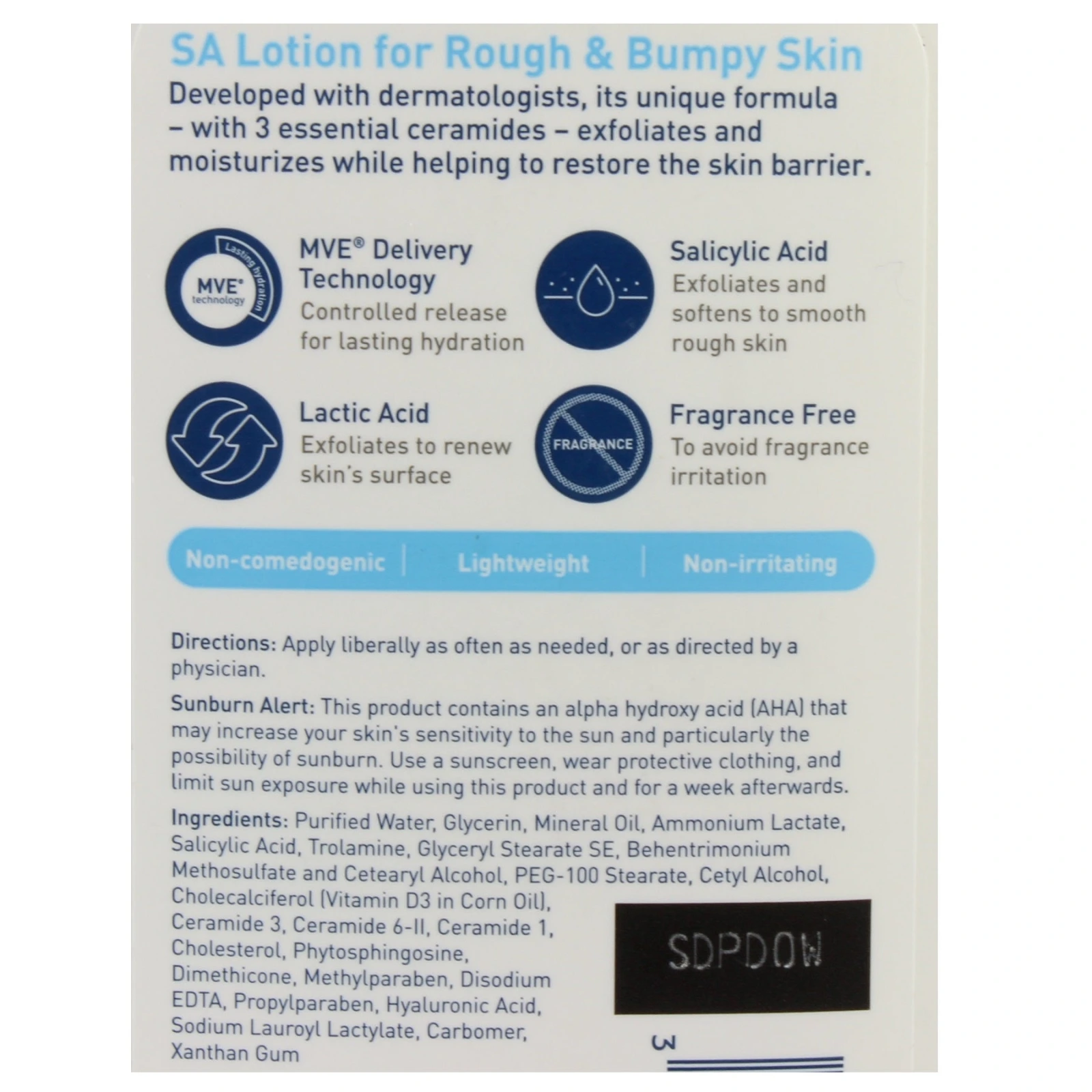
It gets stranger. The 237 ml bottle’s own back label reads, word for word: “Apply to affected areas only or as directed by physician. Do not apply over a large area of the body.” A CeraVe carton panel for the same product reads: “Apply liberally as often as needed, or as directed by a physician.” Those two instructions are opposites, and CeraVe printed both. Follow the bottle in your hand — the restrictive wording is the one on the current pack, and it is the more cautious of the two.
So the brand markets the CeraVe SA Lotion for a condition that is large-area by definition, and labels it “not for large areas”. CeraVe has never squared that circle publicly.
How we would read it, honestly: 3% salicylic acid absorbed across a large surface is a real systemic consideration, which is why the warning exists on a drug label. In practice most people use the CeraVe SA Lotion on both arms without incident. Start with one area, build up, and if you intend to treat arms, thighs and back at once, that is genuinely a conversation for a doctor rather than a product page.
Who Should Use It
The CeraVe SA Lotion suits you if:
- You have rough, bumpy texture on your upper arms, thighs or shoulders that plain moisturiser has never fixed
- You have tried a 2% salicylic acid product and found it did nothing
- You want acids and barrier lipids in one step rather than two products
- You need a fragrance-free body product
- You are an adult — the drug directions specify adults, and no paediatric dosing is published
Look elsewhere if you avoid mineral oil or parabens on principle, if you want a face product, if you need something for broken or actively inflamed skin, or if you are pregnant or breastfeeding and have not spoken to a doctor about salicylic acid.
Suitable Skin Types
| Skin type | Verdict |
|---|---|
| Rough, bumpy, keratosis-pilaris prone | The core use case. This is what it is bought for. |
| Dry and flaky body skin | Strong fit. Acids plus occlusive plus ceramides. |
| Normal body skin | Works, but a plain lotion is probably enough. |
| Sensitive | Caution. A 3% leave-on acid is not a gentle product, and CeraVe makes no sensitive-skin claim for it. |
| Broken, cracked or inflamed skin | No. The label says do not apply to broken skin. |
| Facial skin | Not established — see the FAQ. |
How to Use the CeraVe SA Lotion
Two official direction sets exist, and they are worth reading together.
CeraVe’s consumer instruction: apply to affected areas only, or as directed by a physician. Do not apply over a large area of the body.
The drug label directions: adults, apply to affected areas one to four times daily, or as directed by a health care practitioner.
In practice: apply the CeraVe SA Lotion to clean, dry skin, on the textured patches rather than the whole limb. It absorbs quickly. The best moment is straight after a shower while skin is still slightly damp, which improves how the humectants behave. Wash your hands afterwards and keep it well away from your eyes.
How Often
The label permits up to four times daily. We would not start anywhere near that:
- Week 1 — once daily, on one area only, watching for stinging, redness or peeling
- Week 2 — once or twice daily if week one was uneventful, expanding to a second area
- Ongoing — once or twice daily as your skin allows, dropping to maintenance once texture improves
A 3% leave-on acid does not need help. If you are already using a body scrub, an exfoliating wash or a retinoid, adding the CeraVe SA Lotion on top of all of them is how people end up with raw, irritated arms and blame the wrong product.
The Sunburn Alert
Printed on every CeraVe SA Lotion bottle, and worth reading before you buy:
This is printed on the label, and it is not optional reading. CeraVe’s own wording: this product contains an alpha hydroxy acid that may increase your skin’s sensitivity to the sun and particularly the possibility of sunburn. Use a sunscreen, wear protective clothing and limit sun exposure while using this product and for a week afterwards.
CeraVe Canada names the culprit outright: ammonium lactate. That is the AHA in the CeraVe SA Lotion, and it is why the alert exists.
The week-afterwards clause is the part people miss. Sensitivity does not stop the day you stop applying. If you are treating shoulders or upper arms and then spending a day outdoors in Dhaka, cover up or wear sunscreen on those areas — not just on your face.
Where It Fits in Your Routine
The CeraVe SA Lotion is a leave-on body treatment, so it goes on after cleansing and before anything occlusive.
After a shower: pat dry, apply the CeraVe SA Lotion to the textured areas, let it absorb, then use a plain body moisturiser everywhere else if you want one. Do not layer a second acid on the same patch.
Morning: if you apply in the morning, sunscreen or clothing over the treated areas is not negotiable.
Night: the simpler slot, and the one we would default to. No sun, no interaction with anything else you are wearing.
If you want a gentler daily wash to pair with it rather than a second treatment, browse our body wash and cleansing range.
What to Combine It With
- A plain, unfragranced body moisturiser on untreated areas. See our body lotions and moisturisers.
- Sunscreen or covered clothing on any treated area you take outdoors.
- A gentle, non-exfoliating body wash — you do not need acid in the shower as well.
- Time. Consistency does more for keratosis pilaris than intensity.
Do Not Combine With
- Body scrubs or loofahs on treated areas. Physical scrubbing plus a 3% acid is how bumpy skin becomes raw skin.
- Another leave-on acid on the same patch — glycolic body lotions, high-strength urea creams, at-home peels.
- Topical retinoids on the same area without spacing them out.
- Broken, cracked, sunburned or freshly shaved skin. The label is explicit about broken skin.
- Hot water and long showers immediately before applying, if your skin is already reactive.
CeraVe publishes no interaction guidance for the CeraVe SA Lotion at all. The advice above is general practice with leave-on acids, not brand instruction, and we are labelling it as such.
Realistic Results
What the CeraVe SA Lotion can reasonably do, on a realistic timeline:
| Timeframe | Reasonable expectation |
|---|---|
| First few days | Skin feels softer and better hydrated. Bumps unchanged. |
| 2–3 weeks | Bumps begin to flatten. Roughness noticeably reduced to the touch. |
| 6–8 weeks | The realistic plateau — visibly smoother texture with consistent daily use. |
| If you stop | Texture returns. Keratosis pilaris is managed, not cured. |
What the CeraVe SA Lotion will not do: cure keratosis pilaris permanently, remove the redness underneath the bumps, or work if you use it twice a week. The condition is genetic and chronic. CeraVe publishes no timeframe claim for this product at all, so the table above is our honest estimate from how a 3% leave-on BHA behaves, not a brand promise.
Size and Value
One size, and one common mix-up to avoid when buying the CeraVe SA Lotion:
237 ml is the only size the CeraVe SA Lotion is made in. If someone offers you a 473 ml or a 12 oz “SA Lotion”, check the label — the larger tubs are the SA Cream, a related but different formula with niacinamide in it.
Used on both upper arms once daily, a 237 ml bottle lasts roughly two to three months. Add thighs and it is closer to six weeks, though the label’s large-area caution applies before you plan that.
Against the alternative — an acid body lotion plus a separate ceramide moisturiser — the CeraVe SA Lotion is one bottle doing both jobs, and the ceramides are not a token dusting at the end of the list.
Authenticity and Storage
How to check the CeraVe SA Lotion you receive is the real thing:
Check the barcode against the market your pack claims. The 237 ml pack carries 3606000537712 in the United States, Australia and the UAE; Canadian stock carries 3606000537248. The American pack additionally carries the drug code 82046-248-01. The ingredient panel should match the list below exactly, in that order — and it should include neither urea nor niacinamide.
Store the CeraVe SA Lotion upright at room temperature, capped, out of direct sunlight. Do not decant it into another container.
CeraVe publishes no shelf life and no period-after-opening figure for this product, in any market. As a registered drug the pack carries a printed expiry date and batch code, and that expiry is the only date that means anything. We will not print a reassuring twelve-month symbol the brand never published.
Country of manufacture: the 237 ml bottle states “Made in USA of US and/or Imported Ingredients”, with CeraVe LLC, New York, NY 10001 as the company. That is a qualified statement, not a clean “Made in USA” — the product is assembled in the United States but the raw materials may come from anywhere. CeraVe does not publish this on its website; it is only on the pack. We quote it exactly rather than shortening it into something it does not say.
Full Ingredient List
The CeraVe SA Lotion declaration, in order.
Active ingredient: Salicylic Acid 3%.
Full list, United States and Canada pack. Aqua / Water / Eau, Glycerin, Paraffinum Liquidum / Mineral Oil / Huile Minerale, Triethanolamine, Salicylic Acid, Glyceryl Stearate, Ammonium Lactate, PEG-100 Stearate, Cetearyl Alcohol, Cetyl Alcohol, Zea Mays Oil / Corn Oil, Ceramide NP, Ceramide AP.
Ceramide EOP, Carbomer, Behentrimonium Methosulfate, Dimethicone, Methylparaben, Sodium Lauroyl Lactylate, Cholecalciferol, Cholesterol, Disodium EDTA, Propylparaben, Hydrolyzed Hyaluronic Acid, Phytosphingosine, Xanthan Gum.
Twenty-six ingredients. No urea, no niacinamide, no fragrance. Formulations can change without notice, so the panel on your bottle is the authority.
Warnings and Precautions
These are the CeraVe SA Lotion drug label warnings, reproduced because CeraVe’s marketing page does not show them:
- For external use only.
- Avoid contact with eyes and mucous membranes; if contact occurs, rinse thoroughly with water.
- Discontinue use if excessive skin irritation develops or increases. If irritation persists, consult a health care practitioner.
- If the condition covers a large area of the body, consult a health care practitioner before using this product.
- Do not apply to broken skin.
- Sunburn alert — contains an alpha hydroxy acid. Use sunscreen, wear protective clothing and limit sun exposure while using this product and for a week afterwards.
- Keep out of reach of children. The directions specify adults; no paediatric dosing is published.
- Patch test on a small area before first full use. CeraVe does not instruct this; we do.
- Pregnancy and breastfeeding are not addressed by CeraVe at all for this product. Salicylic acid carries a general caution in pregnancy. Ask a doctor rather than reading the brand’s silence as approval.
Product Specifications
Everything published about the CeraVe SA Lotion, in one place:
| Attribute | Detail |
|---|---|
| Product | CeraVe SA Lotion for Rough & Bumpy Skin |
| Brand | CeraVe (L’Oréal) |
| Size | 237 ml / 8 fl oz — the only size |
| Format | Leave-on body lotion, pump bottle |
| Active ingredient | Salicylic acid 3% |
| Second acid | Ammonium lactate (AHA) — percentage not published |
| Ceramides | NP, AP, EOP, with cholesterol and phytosphingosine |
| Contains | Mineral oil, methylparaben, propylparaben, vitamin D |
| Does not contain | Urea, niacinamide, fragrance |
| Regulatory class | OTC drug (US and Canada) |
| Approved indication | Seborrheic dermatitis and/or psoriasis |
| Use area | Body. Face use not established by the brand. |
| Age | Adults |
| Barcode | 3606000537712 (US/AU/UAE) · 3606000537248 (Canada) · NDC 82046-248-01 |
| Country of manufacture | “Made in USA of US and/or Imported Ingredients” (printed on pack) |
| Shelf life / PAO | Not published — use the printed expiry |
Frequently Asked Questions
How much salicylic acid is in the CeraVe SA Lotion?
3%, declared as the active ingredient on the drug label and by CeraVe Canada. CeraVe’s consumer page does not publish it.
Can I use it on my face?
CeraVe does not say either way for this product — it neither permits nor forbids it. Given it is a 3% leave-on acid carrying a “do not apply over a large area” instruction, we would not recommend it as a face product, and we will not claim the brand approves it. Note that the British SA Smoothing Cream, a different formula, explicitly says body only.
Does the CeraVe SA Lotion contain niacinamide?
No. Many listings say it does; they are copying the SA Cream’s list. There is no niacinamide in this formula.
Does it contain urea?
No. The 10% urea belongs to the SA Smoothing Cream sold in the UK and Europe.
Is it the same as the SA Smoothing Cream?
No — different formulas for different regions. See the comparison table above.
Will it cure keratosis pilaris?
No. Keratosis pilaris is genetic and chronic. The CeraVe SA Lotion manages the texture while you use it; stop, and it returns.
Can I use it on my whole body?
The label says not to, and says to consult a practitioner if your condition covers a large area. Treat affected patches, not entire limbs, and take that instruction seriously rather than as boilerplate.
Do I need sunscreen with it?
Yes, on treated areas, and for a week after you stop. That is the brand’s own sunburn alert, not our addition.
Is it safe during pregnancy?
CeraVe does not address it. Salicylic acid carries a general caution in pregnancy. Ask your doctor.
Can children use it?
The directions specify adults and no paediatric dosing is published, so we would not use it on a child without medical advice.
Is it fragrance-free?
Yes. No parfum or fragrance appears anywhere in the ingredient list.
Does it contain parabens?
Yes — methylparaben and propylparaben. We would rather state that plainly than let you discover it on the bottle.
How long does one bottle last?
Roughly two to three months on both upper arms once daily.
Should You Buy It?
Buy the CeraVe SA Lotion if you have persistent rough, bumpy body texture, a 2% product has already failed you, you want acids and ceramides in the same bottle, and you are comfortable with a genuine 3% active and the label warnings that come with it.
Skip it if you avoid mineral oil or parabens, you are looking for a face product, you want something gentle for sensitive skin, or you are pregnant and have not asked a doctor.
What we like is that the CeraVe SA Lotion is stronger than it looks — a regulated 3% active in a barrier-repair base, at a body-lotion price. What we do not like is how much of that is hidden: the percentage is absent from CeraVe’s own consumer page, the drug status is never mentioned, the approved indication is a different condition entirely, and the “do not apply over a large area” instruction sits oddly against everything the marketing implies. None of that makes it a bad product. It makes it a product that deserves an honest page, which is what this is.
Reviews
There are no reviews yet.