
Description
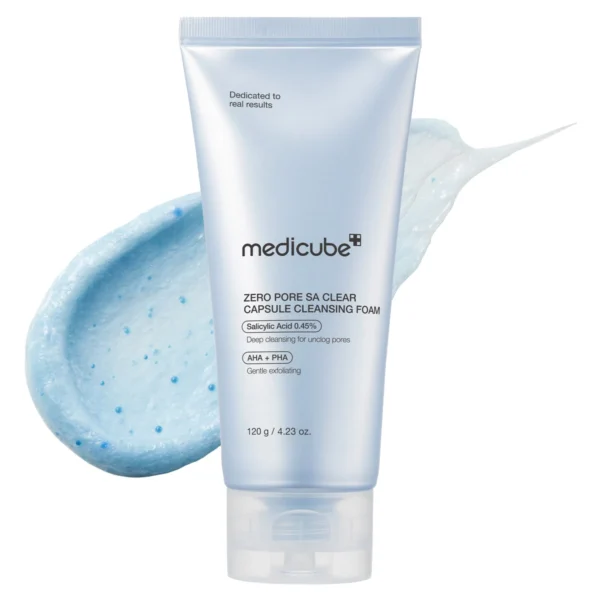
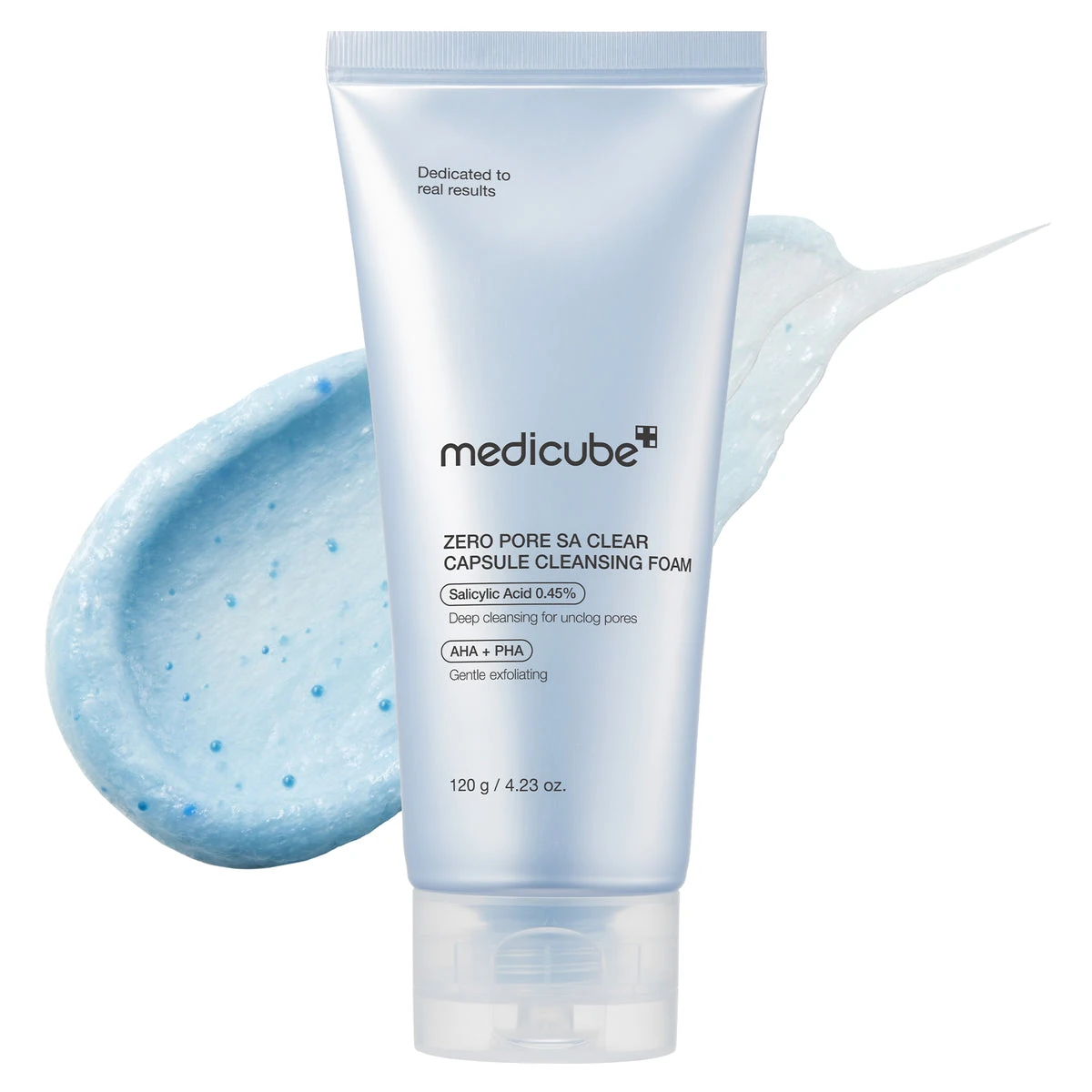
The MEDICUBE Zero Pore Foam Cleanser is a 120 g face wash with blue exfoliating capsules suspended in it. Its full label name is Zero Pore SA Clear Capsule Cleansing Foam, and the carton prints one number worth having: Salicylic Acid 0.45%. This page counts every one of the 44 ingredients, explains what a rinse-off acid can and cannot do, and tells you which of MEDICUBE’s marketing claims we have chosen not to repeat.
Table of contents
Use this table of contents to jump through the Zero Pore Foam Cleanser guide.
- What the Zero Pore Foam Cleanser is
- The surfactant list is the best thing about the Zero Pore Foam Cleanser
- Zero Pore Foam Cleanser: all 44 ingredient positions
- What 0.45% salicylic acid means in a cleanser
- The AHA and PHA sit at the bottom of the list
- The blue capsules in the Zero Pore Foam Cleanser, explained
- How to use the Zero Pore Foam Cleanser
- Where the Zero Pore Foam Cleanser fits in a routine
- How often to use the Zero Pore Foam Cleanser
- Who the Zero Pore Foam Cleanser suits
- Who should skip it
- Bergamot leaf, not bergamot oil
What the Zero Pore Foam Cleanser is
A 120 g / 4.23 oz tube of amino-acid-based cleansing foam with visible blue capsules. It is positioned by MEDICUBE for pores, excess sebum and blackheads, with three exfoliating angles: BHA from the salicylic acid, AHA from mandelic acid and PHA from gluconolactone. It also contains physical exfoliants — silica, corn starch and microcrystalline cellulose — which is what the capsules break down into as you lather.
The surfactant list is the best thing about the Zero Pore Foam Cleanser
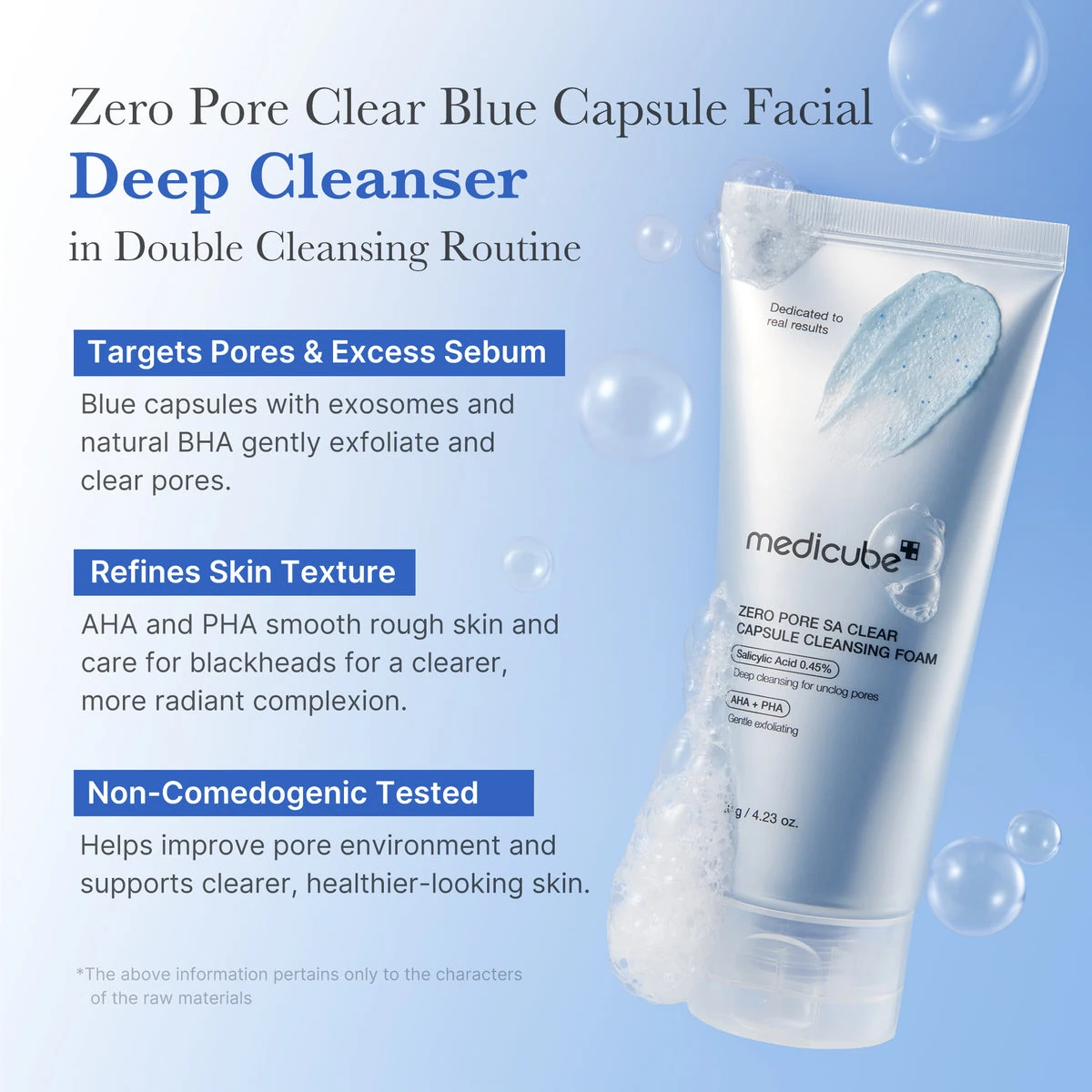
This is where the Zero Pore Foam Cleanser genuinely earns its price. The five cleansing agents are, in order: sodium cocoyl glycinate (3rd), sodium lauroyl glutamate (4th), lauryl hydroxysultaine (5th), coco-glucoside (6th) and decyl glucoside (7th).
Every one of those is an amino-acid or glucoside surfactant. There is no SLS, no SLES and no soap base — no potassium hydroxide reacting with a fatty acid, which is what makes traditional Korean cleansing foams so stripping. Glycerin sits 2nd. If you have used a foaming cleanser that left your face tight and squeaky, this is the structural reason this one should not.
Zero Pore Foam Cleanser: all 44 ingredient positions
- Water — 1st. Glycerin — 2nd.
- Sodium cocoyl glycinate — 3rd through decyl glucoside — 7th. The five mild surfactants.
- Salicylic acid — 9th of 44. The 0.45% on the label.
- Silica — 13th. The physical exfoliant in the capsules.
- Fragrance — 14th.
- Corn starch — 19th, microcrystalline cellulose — 20th. More capsule structure.
- Ultramarines (CI 77007) — 26th. What makes the capsules blue.
- Gluconolactone — 30th (PHA), mandelic acid — 31st (AHA).
- Willow bark extract — 32nd. A natural salicylate source.
- Centella asiatica leaf vesicles — 33rd, centella leaf extract — 34th.
- Bergamot leaf extract — 43rd. Leaf, not fruit oil — see below.
What 0.45% salicylic acid means in a cleanser
Here is the honest framing. 0.45% is a real, meaningful concentration for salicylic acid — leave-on BHA products typically run 0.5% to 2%. But this is a rinse-off product. Contact time is thirty to sixty seconds, and salicylic acid needs both time and the right pH to work into a pore.
So: the salicylic acid in the Zero Pore Foam Cleanser is not doing what a leave-on BHA serum does, and it is not a substitute for one. What it is doing is helping the wash itself clear surface oil and loosen debris a little more effectively than a plain cleanser would. That is a genuine benefit. It is a small one. Anyone selling this to you as blackhead treatment is overselling it.
The AHA and PHA sit at the bottom of the list
Mandelic acid sits 31st and gluconolactone 30th, out of 44. Both are below the 1% line, in a product that then gets rinsed off. MEDICUBE describes them as providing gentle exfoliation and that is a fair description — gentle to the point of being marginal. The exfoliation you actually feel from this product is physical, from the silica capsules, not chemical.
The blue capsules in the Zero Pore Foam Cleanser, explained
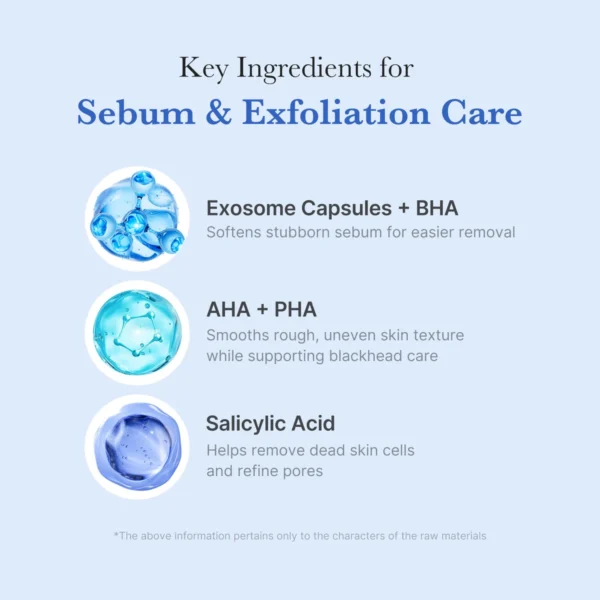
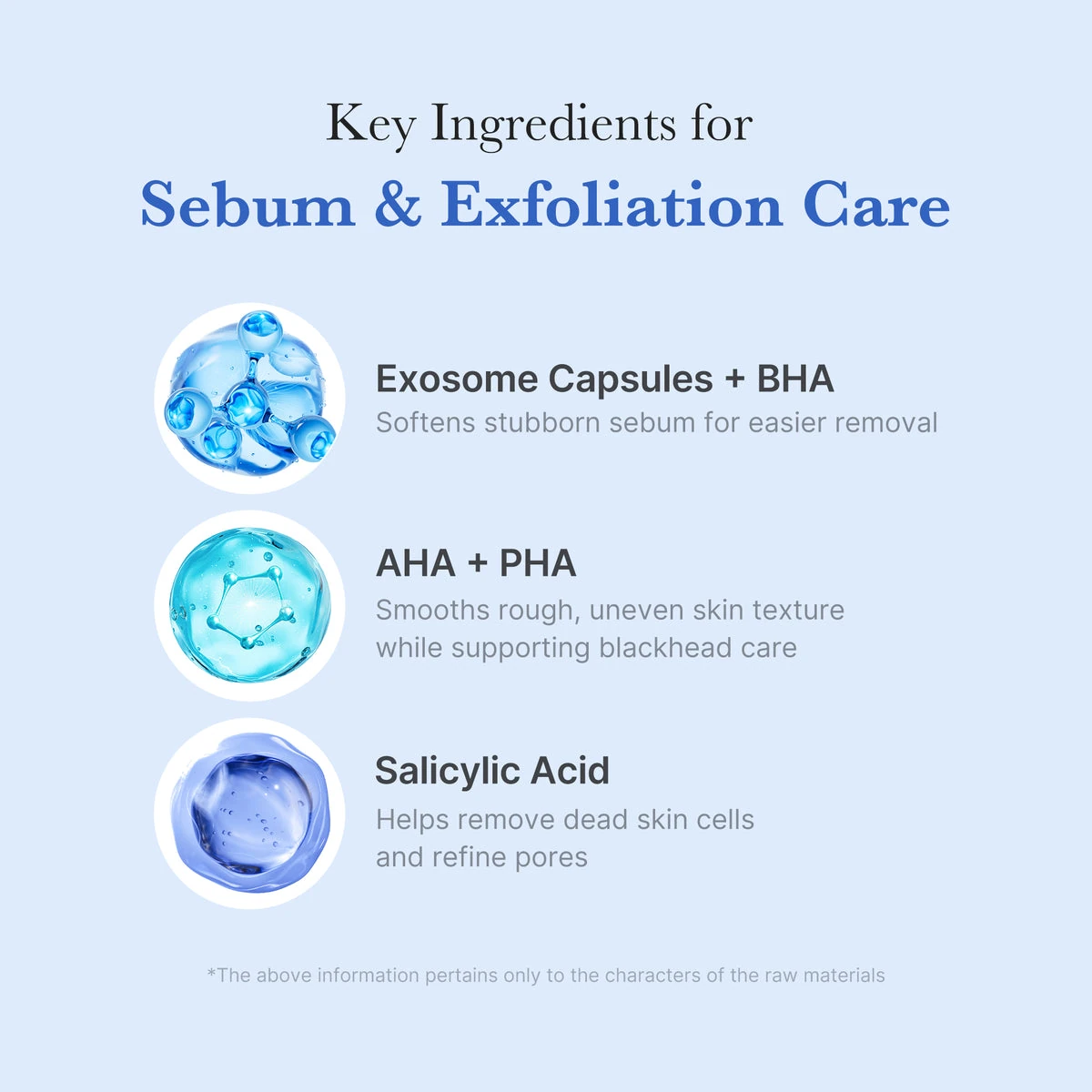
MEDICUBE’s own answer: the capsules are formulated with what it calls Cica Exosome and natural BHA to soften excess sebum, while silica particles gently exfoliate dead skin and pore impurities. In ingredient terms that maps to centella asiatica leaf vesicles at 33rd, willow bark extract at 32nd and silica at 13th. The blue colour is ultramarines at 26th — a pigment, not an active.
They break down as you lather. If you rub the unfoamed product directly on dry skin you will get a much rougher scrub than intended, which is not how it is meant to be used.
How to use the Zero Pore Foam Cleanser
MEDICUBE’s own four steps: squeeze an appropriate amount onto your palm; form a lather by rubbing and mixing with water; apply and massage gently on the face; rinse off with warm water.
The word doing the work there is lather. Build the foam in your hands first with water, then take it to your face. Massaging the unlathered product straight onto dry skin turns a mild cleanser into an aggressive scrub.
Where the Zero Pore Foam Cleanser fits in a routine
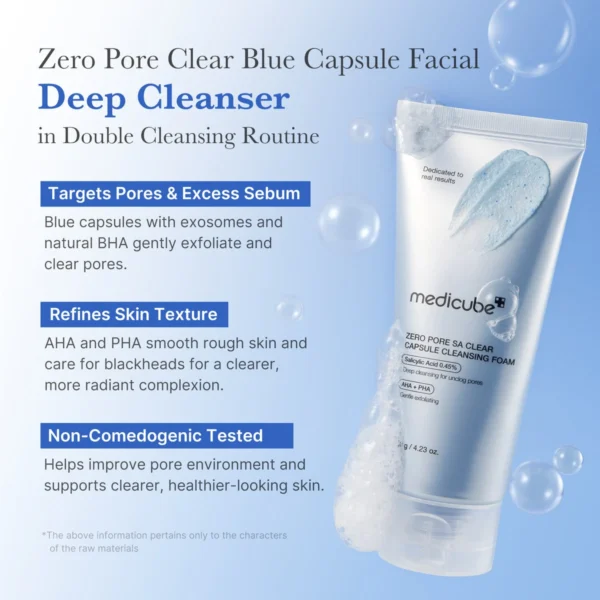
MEDICUBE positions it as the second step of a double cleanse. If you wear sunscreen daily — and you should — an oil or balm first cleanse followed by the Zero Pore Foam Cleanser is the sensible order. On a no-makeup, no-sunscreen evening it works fine on its own.
How often to use the Zero Pore Foam Cleanser
MEDICUBE says the low-irritation formula is designed for gentle daily use. Given the physical capsules, we would say: once daily is comfortable for most people, twice daily is fine for oily skin, and if your skin is dry or sensitive, alternate it with a plain cleanser rather than using it every wash.
Who the Zero Pore Foam Cleanser suits
Oily, combination and congestion-prone skin. It is a good fit if your complaint is midday shine, visible pores across the nose and cheeks, or that gritty texture that builds up over a week. The mild surfactant base means it is also a reasonable choice for people who want a foaming cleanser without the tight feeling.
Who should skip it
Skip it if your skin is dry, currently irritated, or peeling from a retinoid or acid. Skip it if you avoid fragrance — Fragrance sits 14th. Skip it if physical exfoliants bother you, because that is the main thing you will feel. And skip it if you are looking for a treatment product; this is a cleanser and it should be judged as one.
Bergamot leaf, not bergamot oil
Worth being precise about, because these get confused. The ingredient here is bergamot leaf extract at 43rd, not bergamot fruit oil. The furocoumarin concern that attaches to citrus oils applies to the cold-pressed fruit peel oil, not to a leaf extract at the very bottom of a rinse-off formula. This is not a phototoxicity flag.
Zero Pore Foam Cleanser claims we are not repeating
MEDICUBE publishes three figures for this product that we have chosen to leave off our page and out of our gallery:
- A “99.7% of pore-clogging impurities” cleansing figure, shown alongside a before-and-after photograph that the brand’s own footnote marks as illustrative and taken immediately after a single use.
- A “0.00 irritation score”, from a brand-commissioned clinical test.
- An “exosome capsules 1/500 the size of a pore” visual, which the brand footnotes as being for illustrative purposes only.
None of these are lies. They are all brand-commissioned or explicitly illustrative, and we do not think a shop should present them as though they were independent findings. The 0.45% on the carton and the 44 positions above are checkable. Those are what we will put our name to.
Does the Zero Pore Foam Cleanser dry your skin out?
MEDICUBE’s position is no — the amino-acid cleansing agents clean thoroughly while helping maintain moisture. On the ingredient evidence that is a reasonable claim: this surfactant system is genuinely mild. The variable is you. If you already use acids or a retinoid, adding a capsule cleanser twice daily on top can tip your barrier over, and no surfactant list will save you from that.
Using it in Bangladesh weather
Dhaka humidity plus daily sunscreen is exactly the combination this product is built for — the sebum and the SPF residue are what clog things up. In the hot months, twice daily suits most oily skin. In the drier December-to-February stretch, drop to once daily in the evening and use a plain cleanser in the morning, because that is when tightness starts showing up.
Storing the Zero Pore Foam Cleanser
Cap the Zero Pore Foam Cleanser, keep it out of direct sun, and store it upright so the capsules stay evenly distributed. A shelf away from the shower is better than one inside it. Use within twelve months of opening.
Size of the Zero Pore Foam Cleanser and how long it lasts
120 g / 4.23 oz. A pea-sized amount lathers up enough for a full face, so once-daily use puts a tube at roughly three months and twice-daily at six to eight weeks. It is a large tube by Korean cleanser standards.
Amino-acid surfactants versus soap
Traditional foaming cleansers get their lather from soap: a fatty acid such as stearic or myristic acid reacted with potassium hydroxide inside the tube. Soap works, and it works at a high pH — usually around 9 or 10. Skin sits closer to 5. Wash with soap and you push the surface pH up, strip more lipid than you meant to, and leave the barrier to climb back down over the next few hours. That is the tight, squeaky feeling.
Amino-acid surfactants such as sodium cocoyl glycinate and sodium lauroyl glutamate are built differently. They foam at a pH much closer to skin’s own, and they are far less efficient at pulling lipids out of the stratum corneum. Glucosides such as coco-glucoside and decyl glucoside are sugar-derived and milder again. A formula built on five of these and no soap is a deliberate choice, and a more expensive one.
Why physical exfoliation gets a bad name
Scrubs earned their reputation with crushed shells and fruit pits — irregular particles with sharp edges that tear at the surface. Spherical, uniform particles behave differently, and silica beads are about as gentle as physical exfoliation gets. The rule that still applies is pressure: the particle does not decide how rough the experience is, your hand does. Lather it properly, use no pressure, and let the foam carry the particles.
What a cleanser can and cannot change
A cleanser touches your face for under a minute and then leaves. It can remove what is sitting on the surface: oil, sunscreen, pollution, dead cells that were already loose. It cannot restructure a pore, it cannot reduce sebum production, and it cannot fix pigmentation. Choosing a cleanser is mostly about avoiding harm — not stripping the barrier — with a small upside if the formula is clever. This one is clever. It is still a cleanser.
What comes in the box
One 120 g tube with a flip cap, in a printed carton. Nothing else.
Reading a cleanser ingredient list in ten seconds
Two shortcuts cover most of it. First, find the surfactants — they are usually positions three to eight. If you see Sodium Lauryl Sulfate or a fatty acid paired with Potassium Hydroxide, you are looking at a stripping cleanser whatever the front of the tube says. If you see cocoyl, lauroyl or glutamate endings, or anything ending in glucoside, it is a mild one. Second, find where the marketed hero ingredient actually sits. In the Zero Pore Foam Cleanser the salicylic acid is 9th, which is genuinely high; the AHA and PHA are 30th and 31st, which is genuinely low. Two minutes with the back of a tube tells you more than the whole front panel.
Common mistakes with this cleanser
Three worth avoiding. Using it on dry skin without lathering first, which turns a mild wash into a harsh scrub. Using hot water, which strips more than any surfactant in the tube will. And stacking it with an acid toner and a retinoid in the same evening, then blaming the Zero Pore Foam Cleanser when your face reacts. Lather, warm water, one active per night.
What “pore care” actually means
Pore size is largely set by genetics, sebum output and how much sun damage the surrounding skin has taken. Nothing in a tube shrinks a pore permanently. What products can change is how full the pore looks: a pore packed with oxidised sebum and dead cells reads as a dark, wide dot, and the same pore emptied reads as smaller. That is the whole mechanism behind every pore product on the market, this one included. Keep the pore emptied and it looks better; stop and it fills again over a week or two. Anyone promising permanent pore reduction from a cleanser is describing something skin does not do.
Why sunscreen belongs in a pore routine
This surprises people. Sun damage degrades the collagen that holds the pore wall open in a neat circle, and slack pore walls read as larger, more oval pores over years. Daily broad-spectrum sunscreen is the only step with real evidence behind it for keeping pores from stretching with age. Washing well handles today. Sunscreen handles the next decade.
Honest summary
A genuinely well-built daily cleanser with an excellent surfactant list, a real and disclosed 0.45% salicylic acid, and physical exfoliation that you will feel. Its limitations are that the acids get rinsed off before they can do much, that the AHA and PHA are essentially decorative at 30th and 31st, and that it contains fragrance. Buy the Zero Pore Foam Cleanser as a very good cleanser. Do not buy it as a pore treatment.
Authenticity
This Zero Pore Foam Cleanser is authentic MEDICUBE stock in the 120 g tube. All photography on this page is MEDICUBE’s own official imagery, with the claim and before-and-after slides deliberately left out for the reasons above.
Related MEDICUBE products we stock
For the same pore-focused range, we also carry the MEDICUBE Zero Pore Blackhead Mud Mask 100g and the MEDICUBE Zero Pore Pads. If you prefer a non-foaming second cleanse, the MEDICUBE PDRN Hydrating Gel Cleanser 200ml is the gentler option, and the MEDICUBE Kojic Acid Turmeric Toner 250ml is the leave-on exfoliating step this cleanser is not. MEDICUBE lists the full formula on its official product page, and the safety review of salicylic acid as a cosmetic beta hydroxy acid is summarised by the US FDA.
Delivery across Bangladesh
Frequently asked questions
How much salicylic acid is in the Zero Pore Foam Cleanser? 0.45%, printed on the carton, and it sits 9th of 44 ingredients.
Will the Zero Pore Foam Cleanser get rid of my blackheads? It will help keep pores clearer. It is not a blackhead treatment, and a rinse-off BHA cannot do what a leave-on one does.
Does the Zero Pore Foam Cleanser contain sulfates? No. No SLS, no SLES, and no soap base either.
Is the Zero Pore Foam Cleanser fragrance-free? No. Fragrance is 14th on the list.
Can I use it with a retinoid or an acid toner? Yes, but not on the same night as both. Use this as your cleanser and give your actives their own evenings.
Are the blue bits microplastics? No. The exfoliating particles here are silica, corn starch and microcrystalline cellulose. The blue colour is an ultramarine pigment.
Can I use the Zero Pore Foam Cleanser on my body? It is formulated as a facial cleanser. Nothing in it is unsafe elsewhere, but 120 g will not go far on a body.
What is the shelf life? Use within twelve months of opening.
Reviews
There are no reviews yet.