




Description
A salicylic acid cleanser usually asks your barrier to pay for the exfoliation. The Cetaphil SA Cleanser is built on the opposite bet: three mild acids at low strength in a foaming gel base, aimed at people whose skin is both congested and easily provoked.
This page covers what Galderma actually publishes about the Cetaphil SA Cleanser, the one number they conspicuously do not publish, the two different official ingredient lists in circulation, and a sun-sensitivity warning that appears on the Indian label and nowhere on the brand’s own English-language sites.
Table of Contents
- Product Overview
- Two Official Ingredient Lists Exist
- The Triple Acid, Precisely
- Cosmetic, Not an Acne Drug
- Key Benefits
- Key Ingredients
- Three Things We Will Not Claim
- Do Not Confuse It With These
- Who Should Use It
- Suitable Skin Types
- How to Use the Cetaphil SA Cleanser
- How Often
- The Sunscreen Note the Brand Leaves Out
- Where It Fits in Your Routine
- What to Combine It With
- Do Not Combine With
- Realistic Results
- Size and Value
- Authenticity and Storage
- Full Ingredient List
- Warnings and Precautions
- Product Specifications
- Frequently Asked Questions
- Should You Buy It?
Product Overview
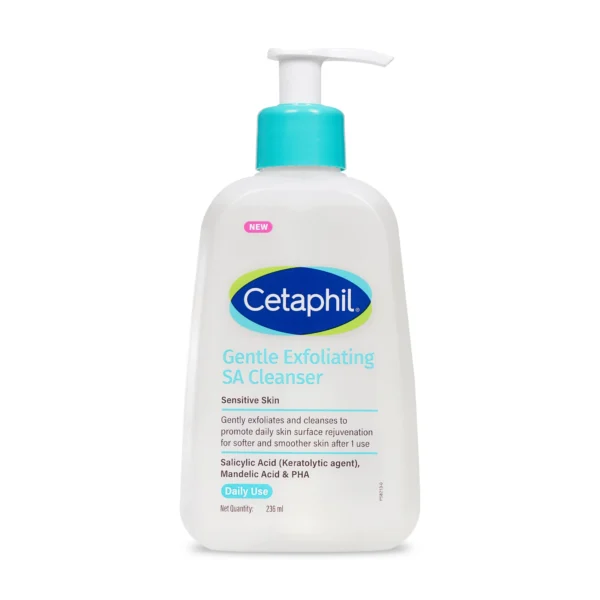
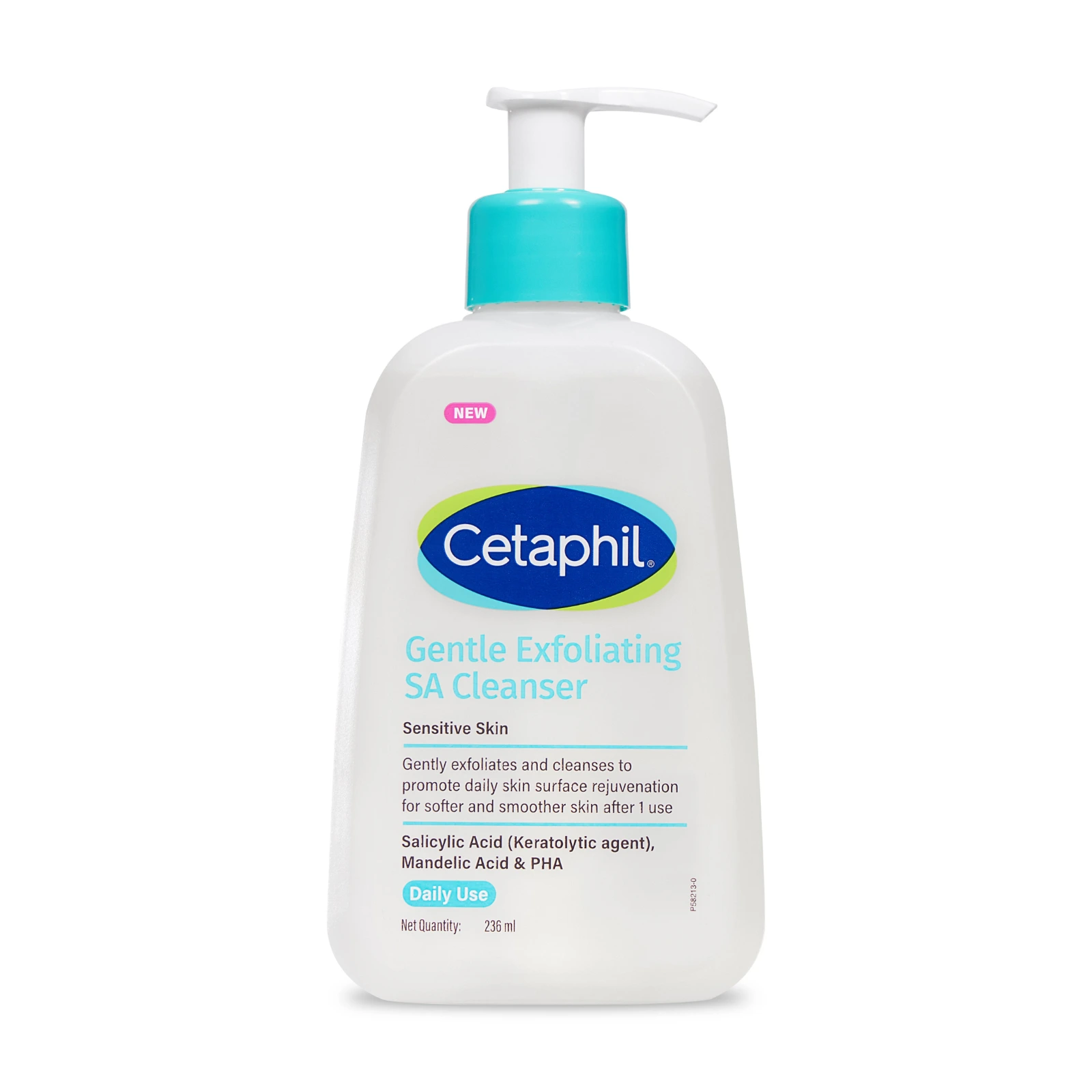
Cetaphil is owned by Galderma, a dermatology company, and has spent decades selling the least dramatic products on the shelf. The Cetaphil SA Cleanser is the brand stepping deliberately into active territory — a foaming gel wash carrying a beta hydroxy acid, an alpha hydroxy acid and a poly hydroxy acid at once, launched as part of a Gentle Exfoliating range in 2024.
The full name depends on which country’s box you are holding. Galderma’s American site calls it the Gentle Exfoliating SA Cleanser. The British site calls the same product the Gentle Exfoliating Salicylic Acid Cleanser, For Face & Body. Australia, Canada, India and Thailand each use their own variant. We list it as the Cetaphil SA Cleanser because that is what people in Bangladesh actually type into a search bar, and because “SA” is the abbreviation printed on the bottle itself.
That British name is worth pausing on, because it carries information the American one drops: face and body. This is not a face wash that happens to be safe elsewhere. Galderma’s UK arm explicitly positions the Cetaphil SA Cleanser for full-body use and singles out people prone to keratosis pilaris — the rough, bumpy upper arms that no amount of ordinary moisturiser fixes.
The 236 ml bottle is the standard retail size. Galderma also publishes a 473 ml pump bottle in several markets and a 29 ml travel mini in India. One Canadian retailer lists a 124 ml size that appears on no Galderma page anywhere, so we do not repeat it.
Two Official Ingredient Lists Exist
This is the part most retailers quietly skip, and it is the first thing you should know before buying the Cetaphil SA Cleanser from anyone.
Galderma publishes two different ingredient lists for this product on its own websites, and they do not reconcile.
| US / Thailand list | UK, EU, Australia, Canada, India list | |
|---|---|---|
| Ingredient count | 23 | 22 |
| Sodium Chloride | Present | Absent |
| Salicylic acid position | 10th | 19th |
| Opening ingredient | Water | Aqua |
The Aqua-versus-Water difference is only a labelling convention. The other two are not. Sodium chloride is either in the formula or it is not. And ingredient-order rules in both jurisdictions require descending concentration order for anything above one percent, so an acid listed tenth — ahead of panthenol, niacinamide and mandelic acid — cannot be the same quantity as an acid listed nineteenth.
Galderma offers no explanation. There is no “reformulated” flag, no batch note, no regional-variant disclosure. Whether these are two formula generations, two regional formulas, or one formula declared two different ways is simply not published.
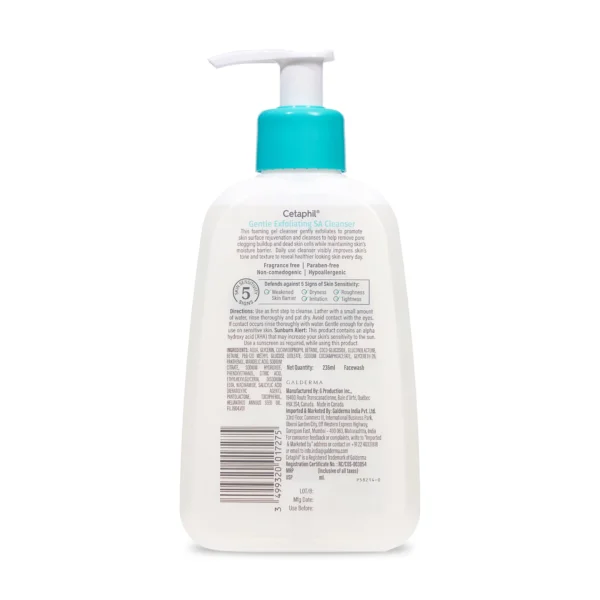
We publish the UK/EU/India list below, because that is the declaration that goes with the 236 ml pack sold through this route. We also print the American list in full, so you can check your own carton rather than trust ours. If the box in your hand lists Sodium Chloride, you have the American declaration.
Both declarations are published by Galderma itself — the Cetaphil UK product page carries the 22-ingredient list and the Cetaphil US product page carries the 23-ingredient one. We would rather point you at both than ask you to take our word for it.
The Triple Acid, Precisely
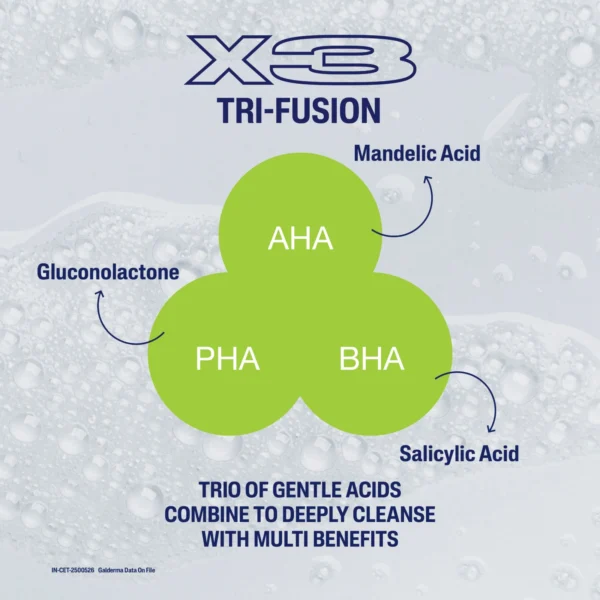
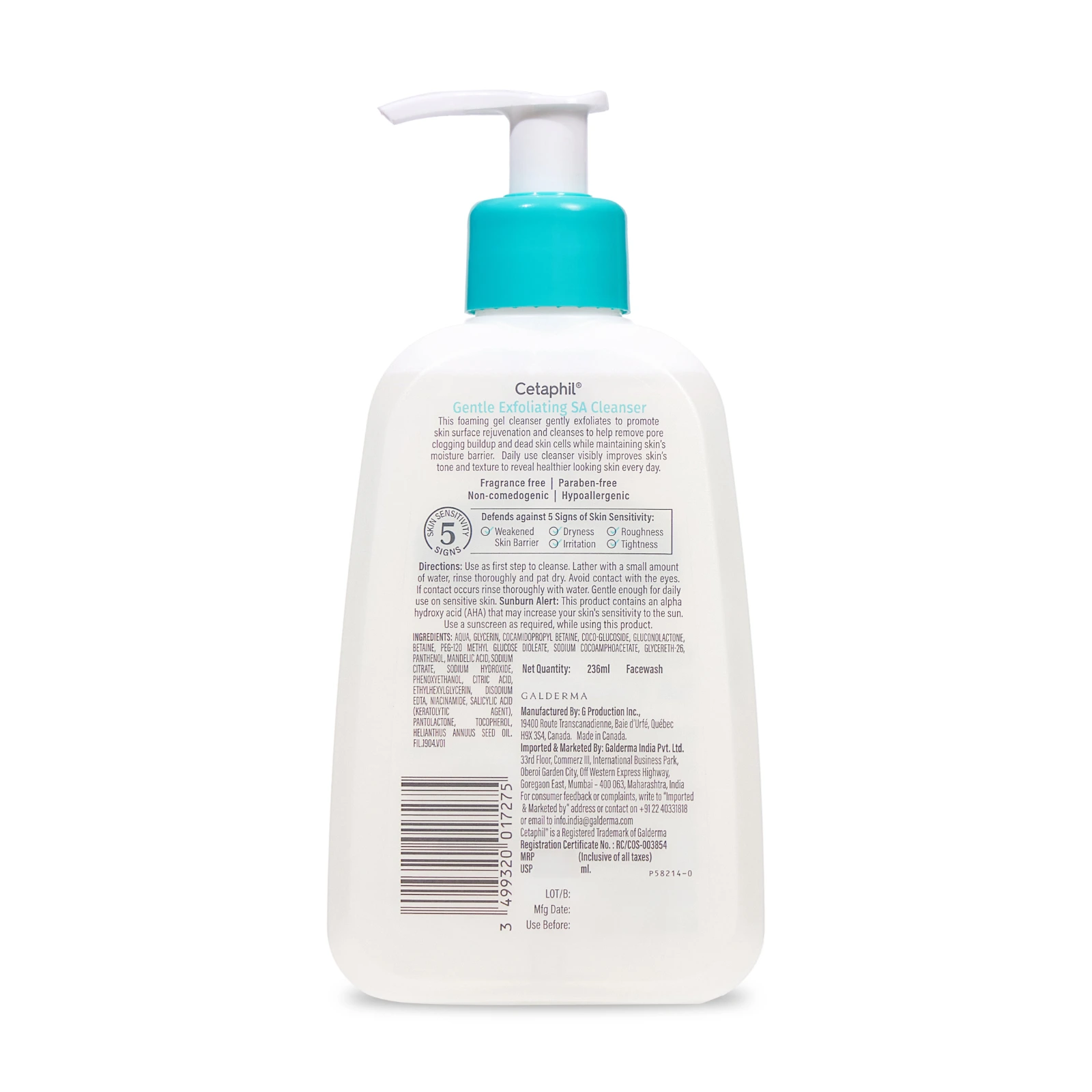
Galderma describes the Cetaphil SA Cleanser as carrying “a unique triple acid blend of Salicylic Acid, Mandelic Acid and Gluconolactone”. Three acids, three different jobs:
- Salicylic acid (BHA) — oil-soluble, so it can travel into a pore lining rather than working only on the surface. This is the ingredient doing the blackhead and congestion work.
- Mandelic acid (AHA) — a large-molecule alpha hydroxy acid derived from bitter almonds. Larger molecules penetrate more slowly, which is why mandelic acid is the AHA usually chosen for reactive skin.
- Gluconolactone (PHA) — the gentlest of the three, sitting fifth in the ingredient list, well ahead of the other two. It exfoliates weakly and holds water, which is part of why this wash does not strip.
Here is what Galderma does not publish: the salicylic acid percentage. Not on the American site, not the British, Australian, Canadian, Indian or Thai site. Not in the corporate launch release — which is telling, because that same release happily quantifies “20% Urea” for a sibling product in the identical range. The omission is a choice, not an oversight.
So we will not print a number. Any Bangladeshi listing quoting a percentage for the Cetaphil SA Cleanser has taken it from a blog, and a blog is not a manufacturer. What can be said honestly is where the acid sits: nineteenth of twenty-two on the pack most likely to reach you, which places it below the one-percent threshold where ingredient order stops being regulated. In a cleanser that is rinsed off within a minute, that is the expected design — contact time is short, so the concentration is not where the work happens.
Cosmetic, Not an Acne Drug
This distinction decides whether the Cetaphil SA Cleanser is right for you, and almost nobody selling it explains it.
In the United States, a salicylic acid product marketed to treat acne is regulated as an over-the-counter drug. It must carry a Drug Facts panel, declare an Active Ingredient with a percentage, and appear in the FDA’s label database. Cetaphil sells exactly such a product: the Gentle Clear Pore Clearing Acne Cleanser, 2% salicylic acid, same brand, same 8 oz size, sitting on the same shelf.
The Cetaphil SA Cleanser is not that. It has no Drug Facts panel, no declared active ingredient, and does not appear in the FDA drug label database at all — while four Cetaphil Gentle Clear products do. It is a cosmetic. Galderma claims exfoliation, texture and tone for it, and pointedly does not claim acne treatment.
Read plainly: if you want a cleanser that visibly smooths texture, loosens congestion and keeps a sensitive barrier intact, the Cetaphil SA Cleanser is designed for you. If you want a declared 2% acne treatment, you want the Gentle Clear, and we would rather send you there than oversell this one.
Key Benefits
What the Cetaphil SA Cleanser is actually good at, stated at the level the evidence supports:
- Three acids, low aggression. A BHA, an AHA and a PHA together cover surface texture and pore congestion without any of them being dosed hard.
- Face and body in one bottle. Galderma’s UK arm names keratosis pilaris directly — the bumpy upper-arm texture that most face products never get used on.
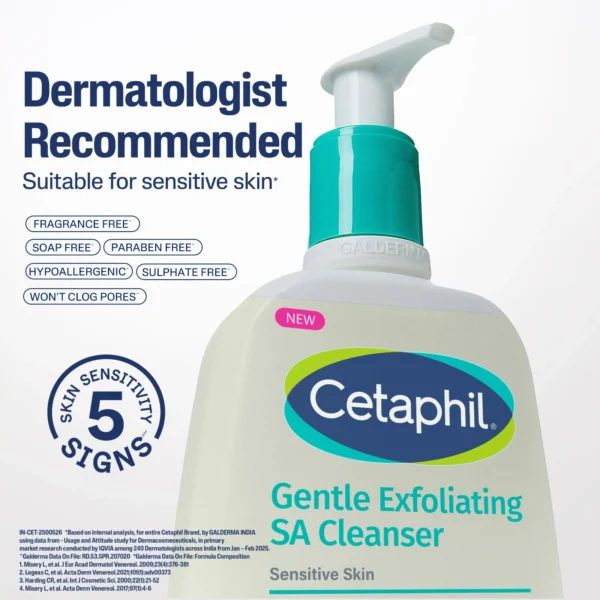
- Genuinely fragrance-free. No parfum, no fragrance, no masking fragrance in either ingredient list. Rare in an exfoliating wash, and verified against both declarations rather than taken from the front of the box.
- Barrier support built in. Glycerin sits second, with panthenol, niacinamide, vitamin E and sunflower seed oil further down.
- Foams without soap-stripping. The surfactant system is cocamidopropyl betaine and coco-glucoside — mild amphoterics and a sugar-based cleanser, not sulphates.
- Daily use is the brand’s own instruction. Galderma states the Cetaphil SA Cleanser is clinically proven gentle enough for daily use on sensitive skin.
- Dermatology-brand supply chain. Galderma is a dermatology company, and the India-market pack is manufactured in Québec, Canada.
Key Ingredients
Reading the Cetaphil SA Cleanser list from the top tells you what kind of product it really is. The first nine ingredients are water, humectants and mild surfactants. The acids arrive after that.
- Glycerin — second in the list, which is unusually high for a wash. This is the reason the skin does not feel tight afterwards.
- Cocamidopropyl betaine and coco-glucoside — the foaming system. Both are mild by design. Cocamidopropyl betaine is worth knowing by name, though; see the honesty section below.
- Gluconolactone — fifth. The PHA, and by position the most abundant of the three acids.
- Betaine — a humectant that also reduces surfactant irritation.
- Panthenol — pro-vitamin B5, soothing and water-binding.
- Mandelic acid — the slow AHA.
- Niacinamide — vitamin B3. In a rinse-off product its contribution is modest; do not buy the Cetaphil SA Cleanser as a niacinamide product.
- Salicylic acid — the BHA.
- Tocopherol and Helianthus annuus (sunflower) seed oil — vitamin E and a light emollient at the tail of the list.
- Phenoxyethanol with ethylhexylglycerin — the preservative system. No parabens.
What is absent matters too: no fragrance, no essential oil, no drying alcohol, no sulphates, no dye.
Three Things We Will Not Claim
Everything below about the Cetaphil SA Cleanser is checkable against Galderma’s own pages. We would rather you find it here than find it later.
1. We will not tell you the salicylic acid percentage. Galderma does not publish it. Any figure you see attached to the Cetaphil SA Cleanser anywhere is somebody’s guess.
2. We will not lean on “hypoallergenic”. Galderma’s American, Australian and Canadian pages all use the word. The British page, listing benefits for the same product, does not — it says non-irritating, fragrance-free, does not clog pores, vegan. Meanwhile the third ingredient in every version is cocamidopropyl betaine, a well-documented contact sensitiser that allergen-screening databases flag by name. “Hypoallergenic” is an unregulated marketing term with no testing standard behind it, and when a brand’s own UK arm declines to use it, that is worth noticing rather than repeating.
3. We will not claim it fades pigmentation. A large American retailer’s listing says this product “reduces hyperpigmentation and post-acne marks”. Galderma claims no such thing — its own wording is smooth, even and radiant-looking skin. Cetaphil India does publish faster and bolder claims than the US or UK markets, including even-looking skin in two days and improved appearance of pigmentation marks in seven; those are India-market marketing claims and we flag them as such rather than presenting them as universal.
Do Not Confuse It With These
Cetaphil’s naming is genuinely confusing, and the wrong bottle will not do what you wanted.
| Product | What it actually is |
|---|---|
| Cetaphil SA Cleanser (this one) | Chemical exfoliant. Salicylic + mandelic + gluconolactone. Cosmetic. |
| Cetaphil Daily Exfoliating Cleanser | Physical scrub using bamboo extract. No salicylic acid at all. |
| Cetaphil Gentle Exfoliating Cleanser (UK) | The bamboo one again, under a name two words away from this product. Contains parfum. |
| Cetaphil Gentle Clear Pore Clearing Acne Cleanser | Declared 2% salicylic acid, regulated as an acne drug. Same brand, same size. |
| Cetaphil PRO Oil Removing Foam Wash | Works through zinc, not acid. Contains masking fragrance. |
The Gentle Clear is the mix-up that costs people the most, because both are Cetaphil, both are 8 oz, and only one of them has a percentage on the label.
Who Should Use It
The Cetaphil SA Cleanser suits you if:
- You have visible texture — rough patches, small bumps, congestion — and previous scrubs made your skin angry
- You want to start chemical exfoliation without committing to a leave-on acid
- You have keratosis pilaris on your arms, thighs or shoulders
- You react to fragrance and need it genuinely absent, not just quiet
- You want one product for face and body rather than two
- You already use a strong leave-on active and want your cleanser to be the mild step
Look elsewhere if you want a treatment-strength acne wash with a declared percentage, if you need a heavy-duty makeup remover — the Cetaphil SA Cleanser is a second cleanse or a morning wash, not an oil cleanser — or if you have an active, broken, or currently inflamed skin barrier.
Suitable Skin Types
How the Cetaphil SA Cleanser behaves on each skin type:
| Skin type | Verdict |
|---|---|
| Oily | Strong fit. Foaming base, oil-soluble BHA. |
| Combination | Strong fit. Follow with moisturiser on dry zones. |
| Normal | Good fit as a texture-maintenance wash. |
| Sensitive | Galderma’s headline claim — clinically proven gentle enough for daily use on sensitive skin. Start every other day regardless. |
| Dry | Workable but reduce frequency. Glycerin helps; acids still exfoliate. |
| Very dry / compromised barrier | Not while the barrier is broken. Repair first. |
Cetaphil Australia additionally tags the Cetaphil SA Cleanser for acne-prone, dull or dehydrated, dryness-prone, eczema-prone and redness-prone skin. That eczema-prone tag comes with no qualifier from the brand, which we find surprising on a triple-acid product — treat it with more caution than Galderma’s own wording implies.
How to Use the Cetaphil SA Cleanser
Galderma publishes different directions in different markets. The fullest version, from the American site, runs five steps:
- Splash your face and body with lukewarm water to prepare the skin.
- Work a small amount of the Cetaphil SA Cleanser into a light foam by mixing it with water in your hands.
- Massage the foam on using circular motions. Avoid harsh rubbing — the point of this product is that you do not need to scrub.
- Rinse thoroughly and pat dry with a soft towel.
- Follow with a lightweight moisturiser.
The British and Australian instructions compress this to a single line: lather with a small amount of water, use over face and body, rinse thoroughly. The substance is the same. Two details matter more than the step count — foam it in your hands first rather than applying neat, and keep contact time short. This is a rinse-off acid, not a mask.
Avoid the eye area. Galderma’s UK warning is explicit: avoid contact with the eyes, and if contact occurs, rinse thoroughly with water.
How Often
Galderma’s own answer for the Cetaphil SA Cleanser is daily, on the strength of a clinical claim about sensitive skin. Our answer is more conservative, and it is not the brand’s:
- Week 1 — every other day, once a day, and watch for tightness or stinging
- Week 2 — daily once a day if week one passed without reaction
- Ongoing — once or twice daily as your skin allows
Three acids in one formula is still three acids. If you are already using a leave-on exfoliant or a retinoid, adding the Cetaphil SA Cleanser daily on top is the fastest way to over-exfoliate without noticing where it came from — the cleanser is the step people forget to count.
The Sunscreen Note the Brand Leaves Out
This one deserves its own section because Galderma’s English-language sites do not mention it at all.
The Indian retail labelling for this product carries a verbatim sunburn alert: the product contains alpha hydroxy acid, which may increase the skin’s sensitivity to the sun, and a sunscreen should be used while using it. The AHA in question is mandelic acid, and mandelic acid is in every published version of the formula.
So the warning is formula-accurate. What is strange is that Cetaphil’s American product page carries no warnings whatsoever, and the British page carries only the eye-contact line. A shopper reading Galderma’s own site would never learn that the Cetaphil SA Cleanser carries an AHA sun-sensitivity alert in another market.
We are repeating it here because it is the safer thing to do. Two honest caveats: this text is published by an Indian pharmacy retailer rather than by Galderma directly, and sun sensitivity from a rinse-off AHA is far lower than from a leave-on acid. Wear daily sunscreen anyway — in Dhaka you need it whether or not you exfoliate.
Where It Fits in Your Routine
The Cetaphil SA Cleanser is a cleanser, so it goes first — but which first depends on the time of day.
Morning: the Cetaphil SA Cleanser, then toner if you use one, then serum, moisturiser, sunscreen.
Evening: if you wear makeup or sunscreen, remove it with an oil or balm cleanser first, then use the Cetaphil SA Cleanser as your second cleanse. It is a gel wash and will not shift long-wear sunscreen on its own.
Body: in the shower, on damp skin, worked into a lather and rinsed. Follow with a body moisturiser on the areas you treated.
One structural note: if you already own a leave-on BHA, run them on alternate days rather than stacking. Browse the rest of our face wash and gel cleansers if you need a plain, non-acid wash for the days in between.
What to Combine It With
The Cetaphil SA Cleanser plays well with the following:
- A simple moisturiser — Galderma’s own final step. Ceramide or glycerin-based works well over an acid wash. See our moisturisers.
- Niacinamide serums — pair comfortably and support the barrier while you exfoliate.
- Hyaluronic acid — replaces the water an exfoliating routine costs you.
- Broad-spectrum sunscreen — non-negotiable alongside any acid.
- Azelaic acid — a reasonable partner for texture and post-acne marks, applied on alternate evenings.
Do Not Combine With
Keep the Cetaphil SA Cleanser away from these, at least in the same session:
- A physical scrub in the same wash. The whole point of the Cetaphil SA Cleanser is that you skip the scrubbing.
- Strong leave-on acids on the same day — glycolic toners, high-strength BHA liquids, weekly peels. Alternate.
- Prescription retinoids in the same session. Space them; use a plain cleanser on retinoid nights if your skin is reactive.
- Benzoyl peroxide immediately before or after, if you are prone to dryness.
- Anything on broken or actively irritated skin.
Galderma publishes no interaction guidance at all for this product, which is a real gap on a triple-acid formula. The advice above is general chemical-exfoliation practice, not brand instruction.
Realistic Results
What the Cetaphil SA Cleanser can and cannot do, on a realistic timeline:
| Timeframe | Reasonable expectation |
|---|---|
| First wash | Skin feels smooth and clean, not tight. No visible change yet. |
| 1–2 weeks | Texture starts to even out. Small surface bumps soften. |
| 4 weeks | Congestion and blackhead visibility reduced. Body texture improving with consistent use. |
| 8–12 weeks | The realistic plateau — consistently smoother tone and texture. |
What the Cetaphil SA Cleanser will not do: clear cystic or hormonal acne, fade established pigmentation, or replace a leave-on treatment. It is a foundation product. Cetaphil India publishes faster timelines than these; we have set expectations to what a rinse-off cosmetic can defensibly deliver.
Size and Value
The 236 ml Cetaphil SA Cleanser is the size most people should buy first. Used once daily on the face, it lasts roughly two to three months; used on face and body it will go considerably faster, which is worth factoring in if keratosis pilaris is your main reason for buying.
Galderma also publishes a 473 ml pump in several markets and a 29 ml mini in India. If you are new to acids, the mini is the sensible trial size where you can find it — but be aware it is distributed in India both as a retail SKU and as a promotional gift, so a sealed retail mini is the one to look for.
One labelling curiosity to note before you compare bottles: every millilitre market states 236 ml, while American third-party listings state 237 ml, and Cetaphil’s US site refuses to give a millilitre figure at all. It is the same 8 fl oz bottle rounded two different ways, not a different quantity.
Authenticity and Storage
Check three things on arrival. The barcode should match the market your pack claims — 3499320017275 for the Indian 236 ml, 5020465203964 for the UK and EU 236 ml, 302990530162 for the American 8 fl oz. The ingredient list should match one of the two declarations printed below, in full, in that order. And the batch code should be legibly stamped rather than stickered over.
Store the Cetaphil SA Cleanser upright, capped, at room temperature, out of direct sunlight, and away from the bathroom window. Do not decant it.
Galderma does not publish a shelf life or a period-after-opening figure for this product — not on any of its six country sites, and not through any major pharmacy retailer we checked. We will not invent one. The batch expiry printed on your carton is the only date that means anything, and we would rather tell you the brand is silent than print a reassuring twelve-month symbol Galderma never published.
Country of manufacture is similarly unpublished by Galderma itself. Indian retail labelling names the manufacturer as G Production Inc. of Baie-d’Urfé, Québec — Galderma’s Canadian production site — with Galderma India as marketer. That covers the India-route pack. We have found no equivalent disclosure for the American or British packs, so we do not claim “Made in Canada” universally.
Full Ingredient List
UK / EU / Australia / Canada / India declaration — 22 ingredients. Aqua, Glycerin, Cocamidopropyl Betaine, Coco-Glucoside, Gluconolactone, Betaine, PEG-120 Methyl Glucose Dioleate, Sodium Cocoamphoacetate, Glycereth-26, Panthenol, Mandelic Acid.
Sodium Citrate, Sodium Hydroxide, Phenoxyethanol, Citric Acid, Ethylhexylglycerin, Disodium EDTA, Niacinamide, Salicylic Acid, Pantolactone, Tocopherol, Helianthus Annuus Seed Oil. The Indian declaration annotates salicylic acid with its function — keratolytic agent — but still gives no percentage.
United States / Thailand declaration — 23 ingredients. Water, Glycerin, Cocamidopropyl Betaine, Coco-Glucoside, Gluconolactone, Betaine, PEG-120 Methyl Glucose Dioleate, Sodium Cocoamphoacetate, Glycereth-26, Salicylic Acid, Sodium Chloride, Panthenol.
Niacinamide, Mandelic Acid, Sodium Citrate, Sodium Hydroxide, Helianthus Annuus (Sunflower) Seed Oil, Tocopherol, Phenoxyethanol, Citric Acid, Ethylhexylglycerin, Disodium EDTA, Pantolactone.
Formulations can change without notice. The carton in your hand is the authority, and given that two official lists exist for the Cetaphil SA Cleanser, reading it is more than a formality here.
Warnings and Precautions
Everything Galderma and its retail partners publish for the Cetaphil SA Cleanser, plus two cautions of our own:
- For external use only.
- Avoid contact with the eyes. If contact occurs, rinse thoroughly with water.
- Discontinue use and consult a dermatologist if irritation occurs.
- The Indian label carries an AHA sunburn alert and advises sunscreen use — see the section above.
- Keep out of reach of children. Galderma publishes no minimum age for this product.
- Patch test on the inner forearm before first facial use. The brand does not instruct this; we do.
- Galderma names no contraindication — no pregnancy note, no rosacea note, no note on active eczema. If any of those apply to you, ask a doctor rather than reading the silence as approval.
Product Specifications
| Attribute | Detail |
|---|---|
| Product | Cetaphil Gentle Exfoliating SA Cleanser |
| Brand | Cetaphil (Galderma) |
| Size | 236 ml |
| Format | Foaming gel cleanser |
| Exfoliants | Salicylic acid (BHA), mandelic acid (AHA), gluconolactone (PHA) |
| Acid percentage | Not published by Galderma |
| Regulatory class | Cosmetic — not an OTC acne drug |
| Fragrance | None |
| Parabens / sulphates | None |
| Use area | Face and body |
| Skin types | All, including sensitive |
| Barcode | 3499320017275 (India 236 ml) / 5020465203964 (UK & EU 236 ml) |
| Country of manufacture | Canada for the India-route pack; not published by Galderma |
| Shelf life / PAO | Not published by Galderma |
| Other sizes | 473 ml, 29 ml mini (market dependent) |
Frequently Asked Questions
What percentage of salicylic acid is in the Cetaphil SA Cleanser?
Galderma does not publish it, in any market. Any percentage you see quoted online is unsourced. If a declared percentage matters to you, the Cetaphil Gentle Clear Pore Clearing Acne Cleanser states 2% on its label.
Can I use the Cetaphil SA Cleanser every day?
Galderma says yes and calls it clinically proven gentle enough for daily use on sensitive skin. We suggest every other day for the first week regardless, then daily if your skin is comfortable.
Morning or night?
Galderma does not specify. Either works. If you use a retinoid at night, morning is the safer slot for the Cetaphil SA Cleanser.
Will the Cetaphil SA Cleanser treat my acne?
It is not an acne treatment and Galderma does not claim it is. It can reduce congestion and blackhead visibility as part of a routine. Active or cystic acne needs a treatment product or a dermatologist.
Does it help keratosis pilaris?
Cetaphil UK names keratosis pilaris explicitly as a use case. Use it in the shower on the affected areas, then moisturise. Expect weeks, not days.
Do I need sunscreen with it?
Yes. The formula contains mandelic acid, an AHA, and the Indian label carries a sunburn alert. Sunscreen is sensible daily practice anyway.
Is it safe for sensitive skin?
That is the brand’s central claim, and the formula supports it — no fragrance, mild surfactants, glycerin second in the list. But cocamidopropyl betaine is a known sensitiser for a minority of people, so patch test.
Is the Cetaphil SA Cleanser fragrance-free?
Genuinely, yes. We checked both official ingredient lists and neither contains parfum, fragrance or masking fragrance. Note that Cetaphil’s UK Gentle Exfoliating Cleanser — a different, bamboo-based product with a nearly identical name — does contain parfum despite being marketed as fragrance-free.
Why does my ingredient list look different from yours?
Because Galderma publishes two. See the section above. Compare your carton against both lists printed here; if it includes Sodium Chloride, you have the American declaration.
Can I use the Cetaphil SA Cleanser on my body?
Yes — the British name for the Cetaphil SA Cleanser literally includes “For Face & Body”, and the directions cover both.
How long does the bottle last?
Roughly two to three months with once-daily facial use. Much faster if you use it on your body too.
Is the Cetaphil SA Cleanser the same as the Cetaphil Daily Exfoliating Cleanser?
No. That one is a physical scrub with bamboo extract and contains no salicylic acid whatsoever.
Should You Buy It?
Buy the Cetaphil SA Cleanser if you want chemical exfoliation from a dermatology brand without a harsh percentage, you have texture or congestion on your face or body, you need genuine fragrance-free formulation, or you want a gentle daily wash that does more than clean.
Skip it if you need a declared-strength acne treatment, you want a leave-on exfoliant, you need a heavy makeup remover, or your barrier is currently damaged.
What we like about the Cetaphil SA Cleanser is that it is honest about its own modesty — three mild acids, short contact time, a barrier-friendly base, and a brand that has resisted the urge to slap a percentage on the front. What we do not like is that the same brand publishes two ingredient lists without explanation, drops “hypoallergenic” in one market while using it in three others, and leaves an AHA sun-sensitivity warning off its own English-language pages. None of that makes it a bad product. It makes it a product worth buying with your eyes open, which is why all of it is printed above rather than buried.

Reviews
There are no reviews yet.