Description
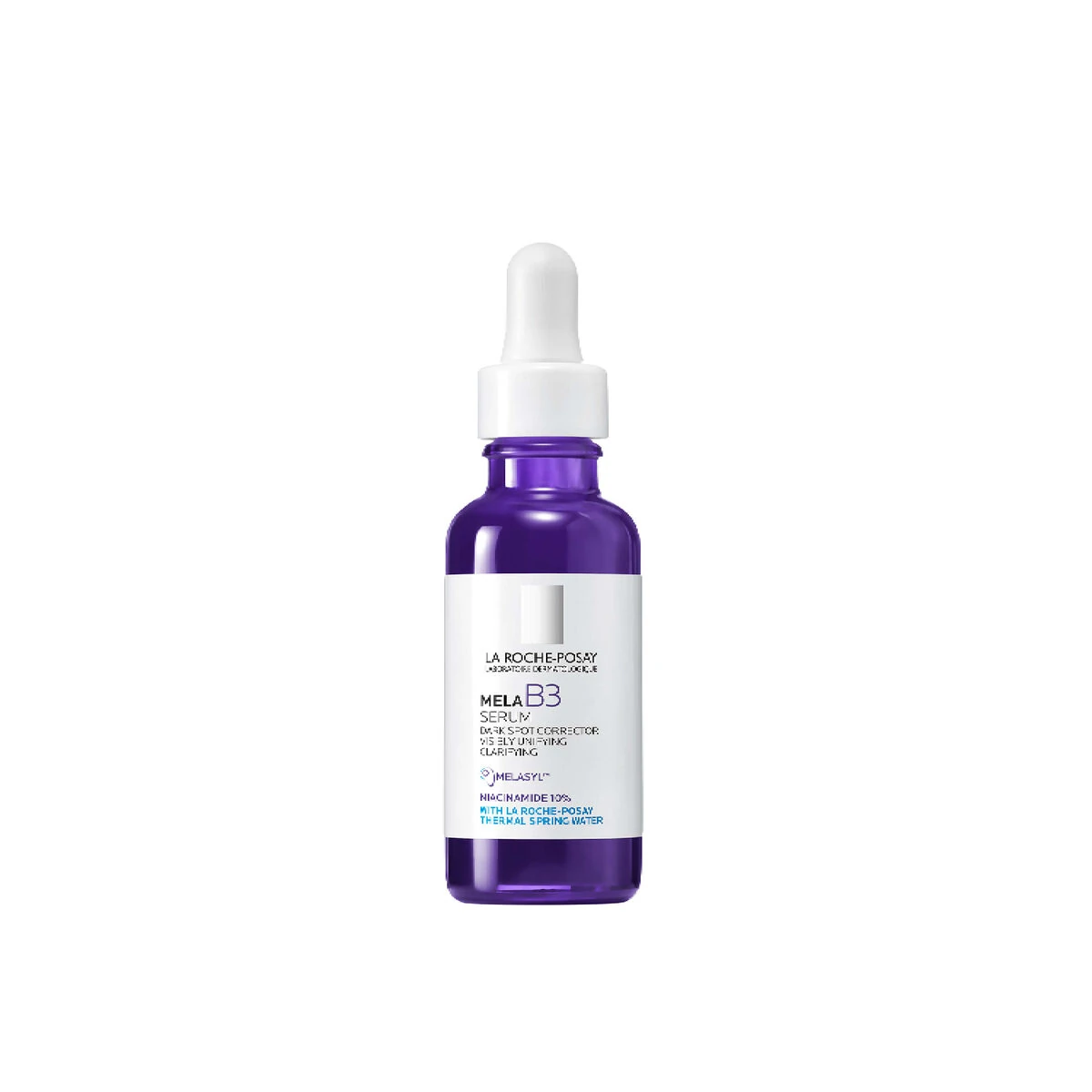
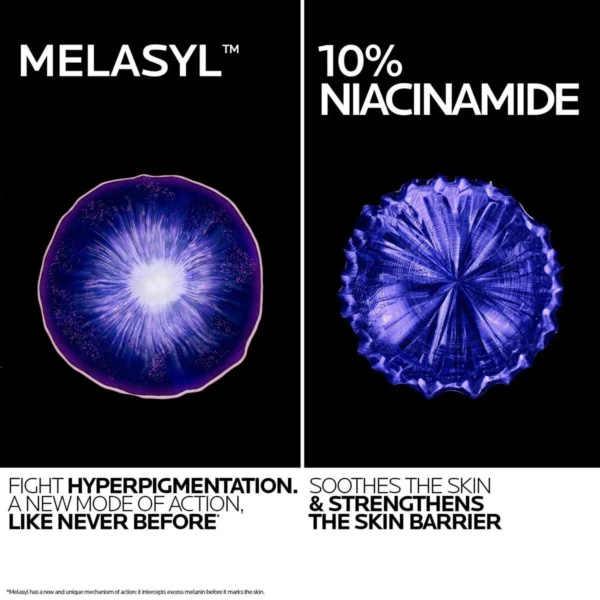
The La Roche-Posay Mela B3 Serum is a 30ml dark-spot serum built around two things: 10% niacinamide and Melasyl, a patented molecule La Roche-Posay describes as a melanin trapper. If you were searching for the Pure Niacinamide 10 Serum, read the next section first — the bottle you receive is almost certainly this one, and the two are not the same formula.
Table of contents
Use this table of contents to jump through the Mela B3 Serum guide.
- Pure Niacinamide 10 or Mela B3 Serum? Read this first
- What the Mela B3 Serum is
- Mela B3 Serum: all 30 ingredients, counted in order
- The Mela B3 Serum 10% niacinamide claim holds up
- Melasyl at 10th: what it is and what is known
- The “retinol” on the box is retinyl palmitate at 27th
- LHA at 20th of 30
- What is not in the Mela B3 Serum
- How to use the Mela B3 Serum
- Sunscreen is not optional with this one
- Realistic timelines for the Mela B3 Serum
- Who the Mela B3 Serum suits
Pure Niacinamide 10 or Mela B3 Serum? Read this first
La Roche-Posay has replaced Pure Niacinamide 10 Serum with Mela B3. Several retailers in Bangladesh — including our own supplier — still list the product under the old Pure Niacinamide 10 name while shipping the purple Mela B3 bottle. We checked the supplier’s own photograph against the ingredient lists to be sure.
This matters because the formulas genuinely differ. The old Pure Niacinamide 10 carried alcohol denat. at 4th place, added fragrance, and mica and titanium dioxide as light-reflecting pigments. The Mela B3 Serum has no alcohol, no fragrance and no pigments on its UK ingredient list. If you tried the old one and found it drying or scented, that complaint does not carry over.
What the Mela B3 Serum is
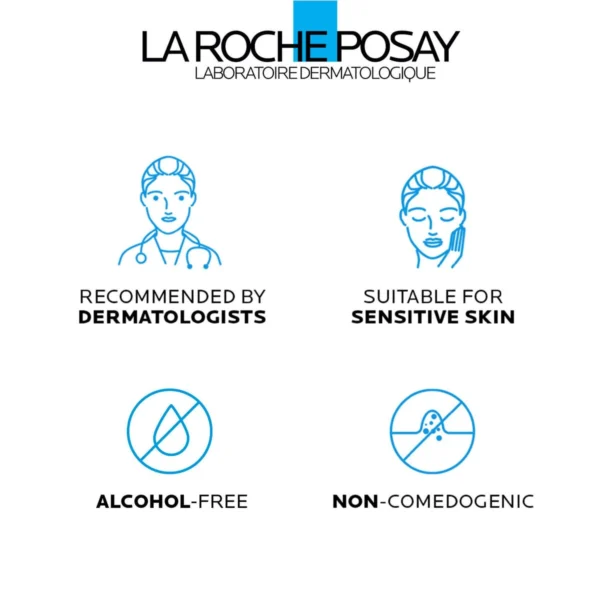
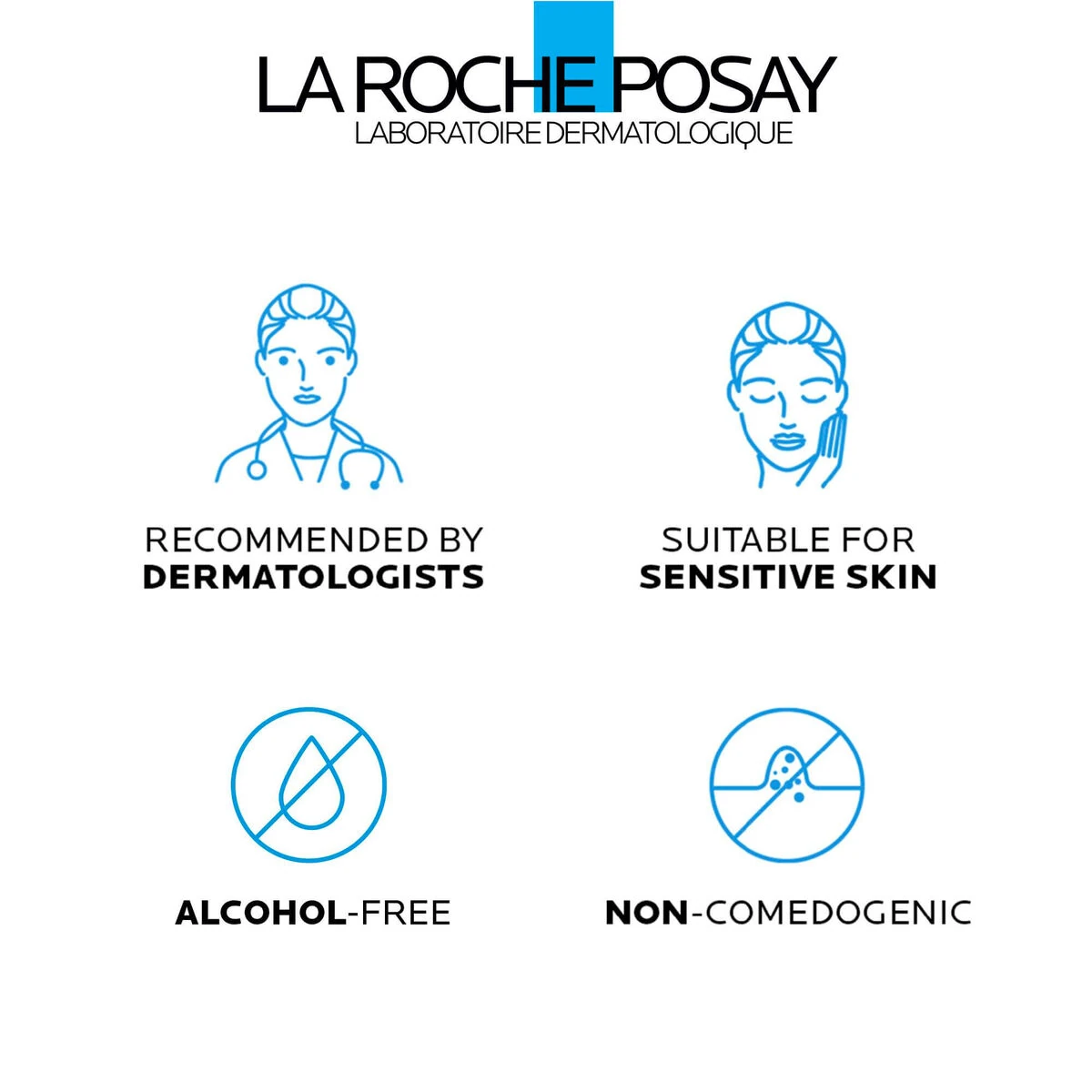
A 30ml lightweight gel-serum for the appearance of dark spots, post-blemish marks and uneven tone. The pack carries four claims: recommended by dermatologists, suitable for sensitive skin, alcohol-free and non-comedogenic. It is a leave-on serum used once or twice daily under moisturiser.
Mela B3 Serum: all 30 ingredients, counted in order
- Aqua / Water — 1st.
- Dimethicone — 2nd. The silicone that gives it slip and a blurred finish.
- Niacinamide — 3rd of 30. This is the stated 10%.
- Glycerin — 4th, propylene glycol — 5th. Humectants.
- Polysilicone-11 — 6th, silica — 7th. Texture and soft focus.
- Bis-PEG/PPG-16/16 PEG/PPG-16/16 dimethicone — 8th.
- Cystoseira tamariscifolia extract — 9th. A brown seaweed extract.
- 2-Mercaptonicotinoyl glycine — 10th. This is Melasyl.
- PEG-20 methyl glucose sesquistearate — 11th.
- Sodium hyaluronate — 12th.
- Sodium hydroxide — 13th, sodium thiosulfate — 14th.
- Carnosine — 15th. An antioxidant dipeptide.
- Poloxamer 338 — 16th, ammonium polyacryloyldimethyl taurate — 17th.
- Dipotassium glycyrrhizate — 18th. Licorice-derived, soothing.
- Caprylic/capric triglyceride — 19th.
- Capryloyl salicylic acid — 20th. This is LHA, the gentle exfoliating acid.
- Caprylyl glycol — 21st, citric acid — 22nd, trisodium ethylenediamine disuccinate — 23rd, xanthan gum — 24th, pentylene glycol — 25th, octyldodecanol — 26th.
- Retinyl palmitate — 27th. See the section below.
- Tocopherol — 28th, pentaerythrityl tetra-di-t-butyl hydroxyhydrocinnamate — 29th. Vitamin E and its stabiliser.
- Phenoxyethanol — 30th and last. The preservative.
The Mela B3 Serum 10% niacinamide claim holds up
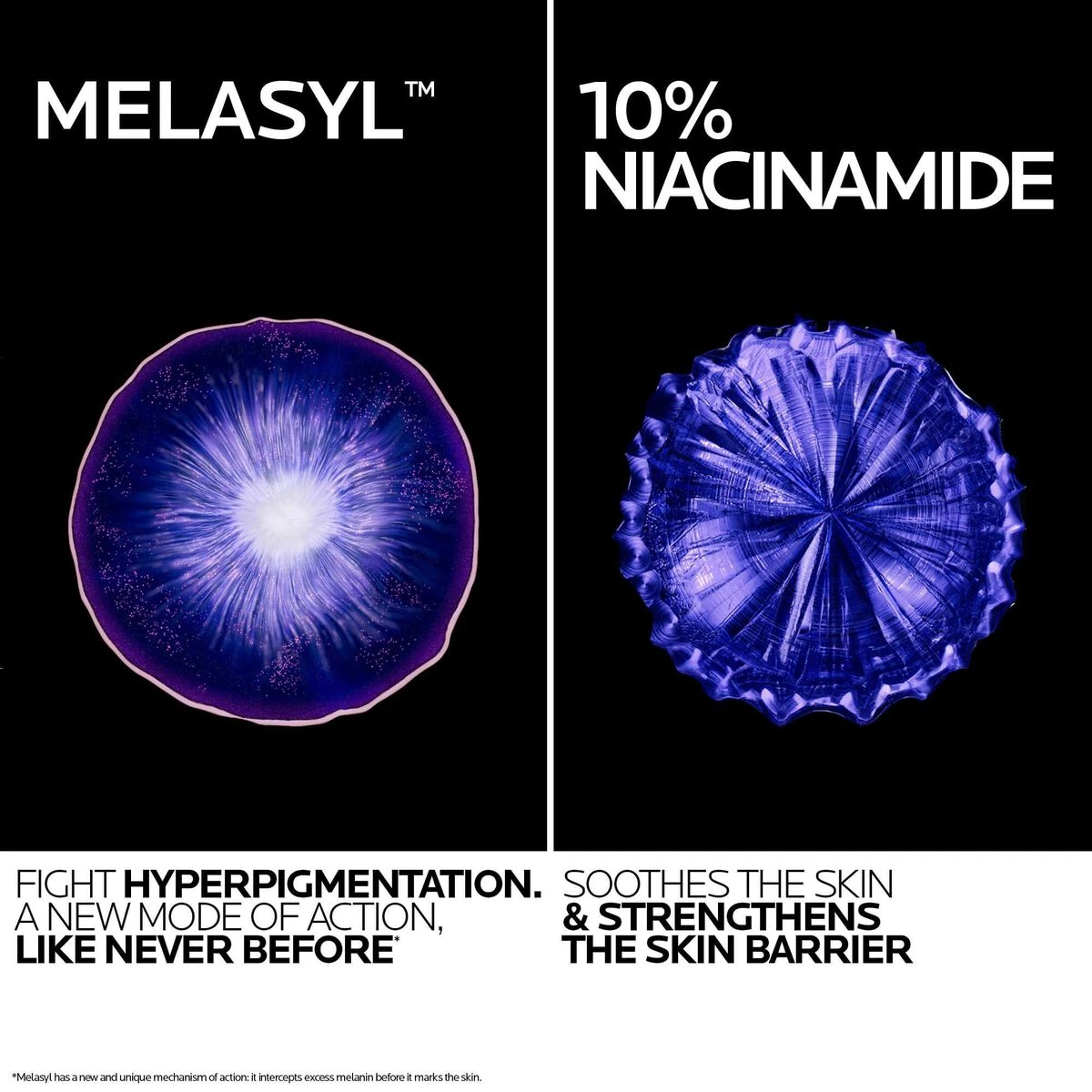
Niacinamide sits 3rd of 30, behind only water and dimethicone. On a list this length, that is exactly where a 10% inclusion belongs. This is the ingredient in the Mela B3 Serum with the deepest published record — for the appearance of uneven tone, for barrier support, for sebum and for pore appearance — and it is the reason to buy the product.
Melasyl at 10th: what it is and what is known
Melasyl is La Roche-Posay’s trade name for 2-mercaptonicotinoyl glycine, a molecule L’Oréal spent years developing and patented. The mechanism the brand describes is interception: rather than blocking tyrosinase like most brightening actives, it is said to capture melanin precursors before they become pigment.
Being honest about the evidence: this is a genuinely new molecule with real patent work behind it, and the published independent literature is still thin because it is recent. La Roche-Posay’s own studies support it. Independent replication is not there yet in the way it is for niacinamide. It sits 10th of 30 here, which is a real inclusion rather than a token one. Buy the Mela B3 Serum for the niacinamide; treat the Melasyl as a promising extra rather than the proven part.
The “retinol” on the box is retinyl palmitate at 27th
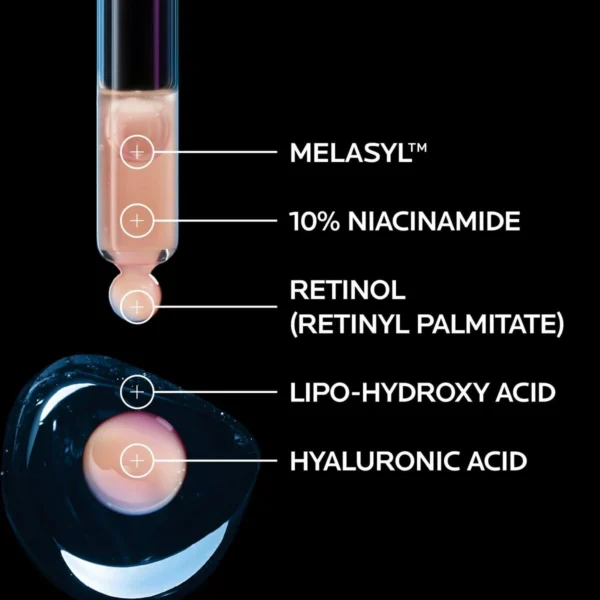
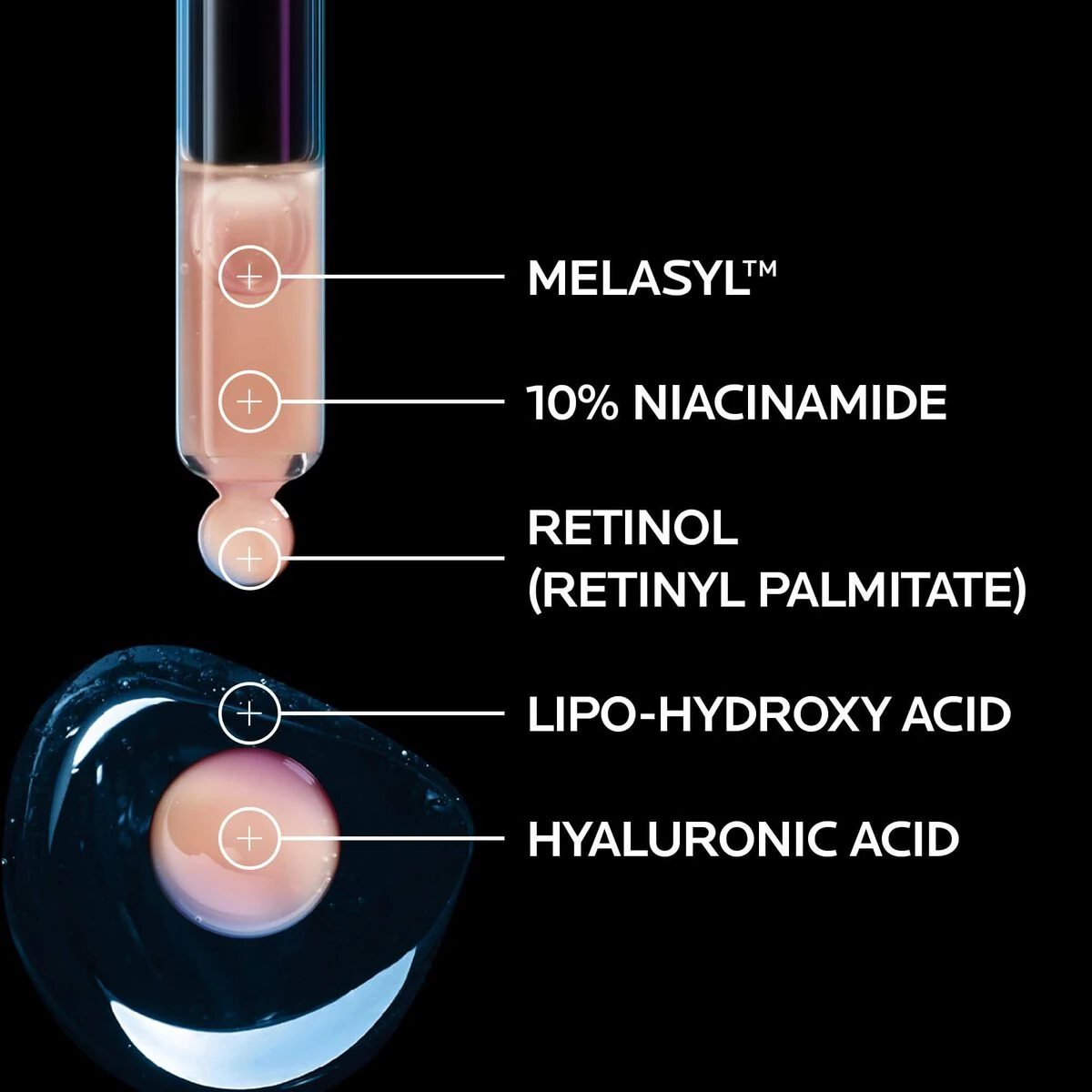
La Roche-Posay’s own key-ingredient graphic lists “Retinol (retinyl palmitate)” among the actives. We appreciate that it names the actual molecule, because those are not the same thing. Retinyl palmitate is an ester of vitamin A — the weakest, most stable member of the retinoid family, which your skin has to convert twice before it does what retinol does.
And it sits 27th of 30, in among the antioxidants and preservatives. That is a trace amount of the mildest retinoid. If you are buying the Mela B3 Serum expecting retinoid results, you should buy an actual retinol product instead. What the retinyl palmitate is realistically doing here is contributing a little antioxidant support alongside the tocopherol.
LHA at 20th of 30
Capryloyl salicylic acid, known as LHA, is La Roche-Posay’s proprietary lipophilic derivative of salicylic acid. It exfoliates more gently and more evenly than plain BHA because the larger molecule penetrates more slowly. At 20th of 30 it is a supporting player, not the main event — enough to help surface turnover, not enough to be a peel.
What is not in the Mela B3 Serum
No alcohol denat. No parfum or fragrance on the UK ingredient list. No mica or titanium dioxide, so nothing here is optically faking a brighter complexion — anything you see is the formula working, not pigment sitting on the surface. No parabens. Preservation is phenoxyethanol at 30th plus caprylyl glycol at 21st.
How to use the Mela B3 Serum
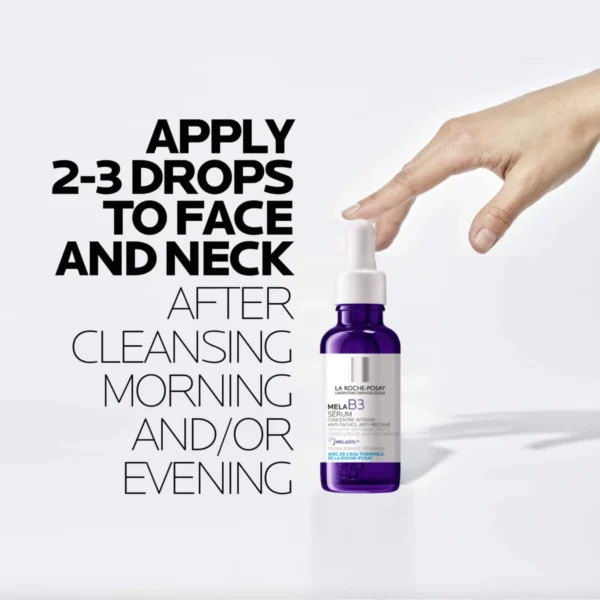
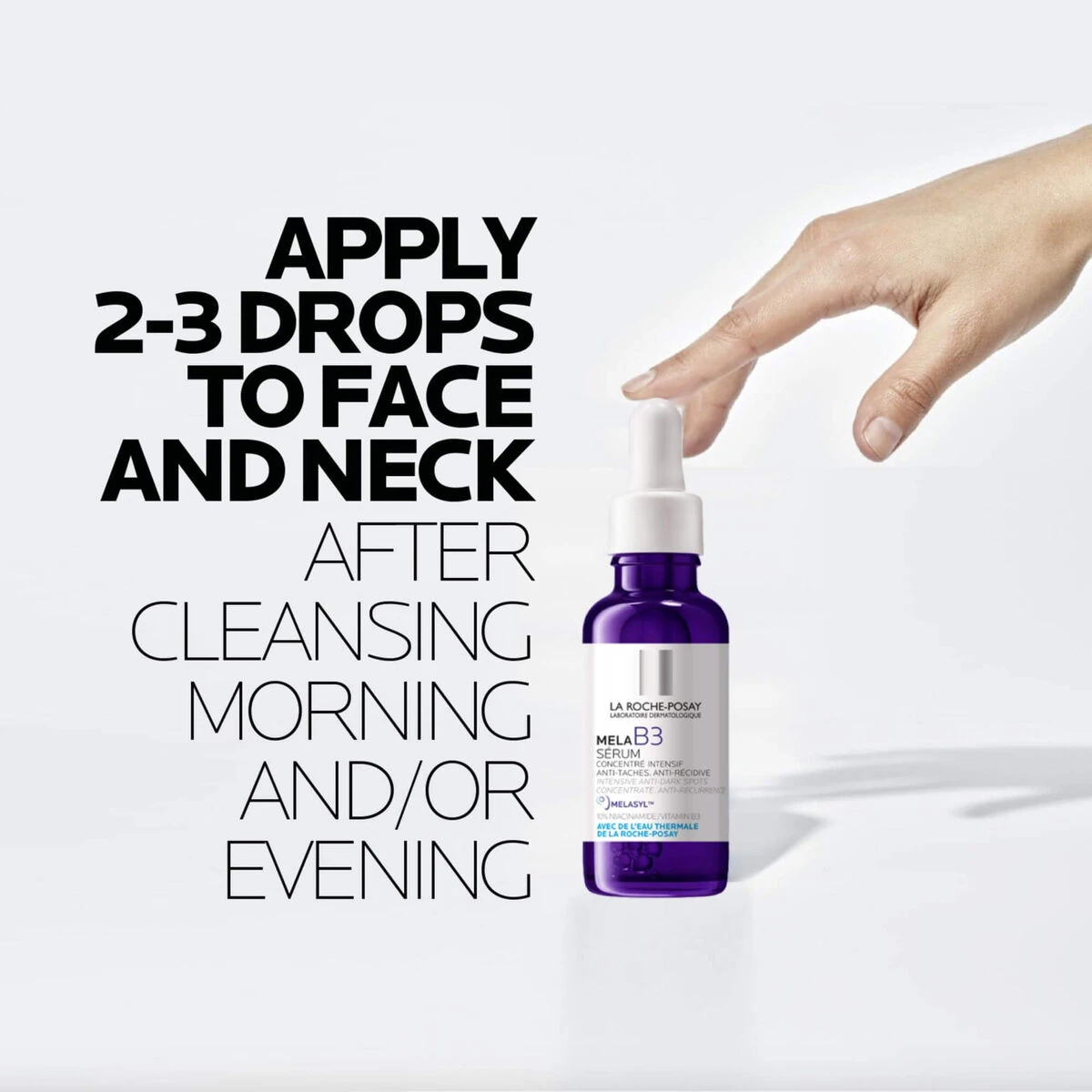
La Roche-Posay’s own instruction: apply 2-3 drops to face and neck after cleansing, morning and/or evening.
Two to three drops genuinely is enough for a face — this is a spreadable gel and overapplying wastes an expensive bottle. Press it in rather than rubbing, wait a minute, then moisturiser. In the morning, sunscreen goes on last, without exception.
Sunscreen is not optional with this one
Every pigmentation product is working against a process that ultraviolet light drives. Using the Mela B3 Serum without daily broad-spectrum sunscreen is emptying a bucket with the tap running — you will not see the result, and you may see the spots deepen. In Bangladeshi sun this is the single biggest determinant of whether the product does anything for you at all. There is also LHA in the formula, which is one more reason to protect the skin.
Realistic timelines for the Mela B3 Serum
Pigmentation is slow. Eight to twelve weeks of consistent daily use with sunscreen is a fair window before you judge the Mela B3 Serum, and stubborn melasma may need longer and may need a dermatologist alongside it. Anyone promising visible change in two weeks is selling. Post-blemish marks generally respond faster than sun-driven spots, which respond faster than melasma.
Who the Mela B3 Serum suits
Anyone dealing with post-acne marks, sun spots or general unevenness who wants a well-formulated, fragrance-free, alcohol-free option. It is also a reasonable choice for sensitive skin — the pack claims it and the ingredient list supports it, with licorice-derived dipotassium glycyrrhizate at 18th as a soothing agent.
Who should think twice
If you avoid silicones, dimethicone at 2nd and polysilicone-11 at 6th make this the wrong product. If you are pregnant or nursing, retinyl palmitate is present — a trace at 27th, but check with your doctor rather than taking a shop’s word for it. If you have diagnosed melasma, see a dermatologist; a cosmetic serum is a supporting act there, not the treatment. And if your budget is tight, plain niacinamide costs far less and is doing most of the work here.
Why we are not showing the 94% figure
La Roche-Posay publishes a “dark spots clinically reduced for 94%” graphic and a before-and-after photograph for this product. Both are out of our gallery. The figure is footnoted as an instrumental measurement of the overall area of dark spots after four weeks — which is a real measurement, but “94% of subjects showed some reduction in measured area” reads very differently from “94% fewer dark spots”, and a product page invites the second reading. We would rather give you the ingredient positions.
Layering the Mela B3 Serum
It layers cleanly under moisturiser and sunscreen. Keep it away from a strong direct-acid or high-strength vitamin C step in the same sitting — not because of a specific incompatibility, but because the LHA is already there and stacking exfoliants is how people end up irritated. If you use a retinoid, run it on alternate evenings.
What the Mela B3 Serum feels like
A light, slightly silky gel that spreads far and sinks in fast, leaving a smooth, blurred finish from the silicones and silica. No stickiness. It sits well under sunscreen and makeup. The liquid itself is faintly tinted from the formula, not from added pigment.
Patch testing the Mela B3 Serum
Apply a small amount inside your forearm once a day for three days and leave it on. Watch for redness, itching or persistent stinging. If nothing happens, try a patch by the jaw for two more days before going full face. Worth doing even on an alcohol-free, fragrance-free formula.
Using it in Bangladesh
Two practical points. First, sun exposure here is high year-round, so the sunscreen rule above carries more weight than it would in a colder country — reapply if you are outdoors for long stretches. Second, the gel texture suits the humid months well; in the drier December-to-February weeks put a proper moisturiser over the top, because the Mela B3 Serum is a treatment step and not a hydrator.
Storing the Mela B3 Serum
Cap the Mela B3 Serum, keep it upright, out of direct sunlight and away from heat. Antioxidants and retinoid esters both degrade with light and warmth. Use within twelve months of opening.
Size of the Mela B3 Serum and how long it lasts
30ml with a dropper. At two to three drops once daily, a bottle runs roughly two to three months; twice daily, about six weeks. That is normal for a 30ml serum and it makes the per-day cost easier to judge against the price.
What we will not claim
We will not tell you the Mela B3 Serum whitens skin, bleaches, or removes dark spots permanently. We will not quote the 94% figure. We will not call retinyl palmitate at 27th place “retinol treatment”. What we will give you is the full ingredient list in order, the two figures La Roche-Posay actually publishes, and a clear statement of which bottle you are receiving.
How pigmentation actually forms
Worth understanding, because it explains why every honest answer here is slow. Melanocytes sit at the base of the epidermis and manufacture melanin inside packets called melanosomes, which are then handed off to the surrounding skin cells. Ultraviolet light, inflammation and hormones all crank that production up. The pigment then rides upward with the cells as they mature, which is why a spot you triggered today only becomes visible weeks later — and why it takes weeks more to clear once you stop feeding it.
Different actives interrupt different steps. Niacinamide interferes with the handoff from melanocyte to skin cell. Tyrosinase inhibitors slow the manufacturing enzyme. Exfoliants speed the exit of pigment already on its way out. Melasyl’s proposed action is a fourth one: capturing precursors before they finish becoming melanin. A product touching several steps at once is a reasonable design, and it is also why nothing works overnight.
Why we quote positions instead of percentages
Cosmetic ingredient lists are legally ordered by weight down to 1%, after which the manufacturer may order the remainder freely. So the position of an ingredient is real information, and it is information anyone can check against the box in their hand. Percentages, by contrast, are disclosed only when a brand chooses to. La Roche-Posay discloses one figure for this product — the 10% niacinamide — and we have repeated it because they published it. Everywhere else on this page you get position, because that is what can be verified.
A simple routine that works
Morning: gentle cleanser, two to three drops of this, moisturiser, sunscreen. Evening: cleanser, this, moisturiser. That is it. Pigmentation routines fail more often from irritation caused by piling on actives than from any single product being too weak. Add one thing at a time and give it a month.
What comes in the box
One 30ml glass bottle with a rubber-bulb dropper, in a printed carton. Nothing else, and no applicator tool.
Post-acne marks are not scars
Worth separating, because they need different answers. A flat brown or red mark left behind after a spot heals is post-inflammatory hyperpigmentation — pigment, sitting in skin whose surface is otherwise intact. That is what a serum like this can genuinely help fade, and it usually fades on its own eventually too, just slower.
A scar is different: the texture itself has changed, either pitted or raised, because collagen was lost or overproduced during healing. No topical serum rebuilds that. If you run your finger over a mark and feel a dip or a ridge, you are looking at a scar and the honest answer is a clinic — microneedling, laser or a dermatologist-led plan. If it is flat and only a colour difference, this is the right category of product.
Why picking undoes the work
The most common reason a pigmentation routine goes nowhere is that new marks keep being created faster than old ones fade. Every squeezed spot drives inflammation deeper, and inflammation is one of the three main triggers for melanin production alongside ultraviolet light and hormones. Sunscreen every morning and hands off your face are, unglamorously, worth more than any serum in the routine.
Honest summary
A well-built pigmentation serum whose strongest card is 10% niacinamide at 3rd place, supported by a genuinely novel patented molecule at 10th and gentle LHA at 20th. It is a real improvement on the Pure Niacinamide 10 it replaced — no alcohol, no fragrance, no cosmetic pigments. Its limits are that Melasyl’s independent evidence is still young, that the retinyl palmitate is marketing more than mechanism, and that it is expensive for what is fundamentally a niacinamide serum with extras.
Authenticity
This Mela B3 Serum is authentic La Roche-Posay stock. The ingredient list here is transcribed from La Roche-Posay’s own published UK listing for Mela B3, and all photography is the brand’s official imagery for the 30ml bottle. We have excluded the before-and-after photographs and the clinical percentage graphic. If the invoice or the outer listing says “Pure Niacinamide 10”, the bottle inside is Mela B3 — that is the supplier’s naming, not a substitution by us.
Related La Roche-Posay products we stock
Pair it with a moisturiser from the same house: the Toleriane Double Repair Matte 100ml for oily skin or the Toleriane Double Repair 100ml for normal to dry. If the LHA in this formula leaves any patch feeling tight, the Cicaplast Baume B5+ is the repair balm to keep beside it. La Roche-Posay publishes the full formula on its official Mela B3 product page, and background on niacinamide and other cosmetic ingredients is published by the US FDA.
Delivery across Bangladesh
Frequently asked questions
Is this the same as Pure Niacinamide 10 Serum? No. Mela B3 replaced it. Different formula — the old one contained alcohol denat. at 4th place and fragrance; this one contains neither.
How much niacinamide is in the Mela B3 Serum? 10%, stated by La Roche-Posay. Niacinamide sits 3rd of 30 ingredients, which is consistent.
What is the Melasyl in the Mela B3 Serum? La Roche-Posay’s trade name for 2-mercaptonicotinoyl glycine, a patented molecule at 10th place on the list.
Does the Mela B3 Serum contain retinol? It contains retinyl palmitate, the weakest vitamin A ester, at 27th of 30. That is not a retinol treatment.
Is the Mela B3 Serum fragrance-free? There is no parfum on La Roche-Posay’s UK ingredient list, and the pack states alcohol-free and non-comedogenic.
Can I use it with vitamin C? Use them at opposite ends of the day rather than stacking. Vitamin C in the morning, this in the evening, works well.
How long until I see something? Eight to twelve weeks with daily sunscreen. Faster on post-blemish marks, slower on sun damage and melasma.
Is it safe in pregnancy? It contains a trace of retinyl palmitate. Ask your doctor — we are not going to make that call for you.
Reviews
There are no reviews yet.