Description
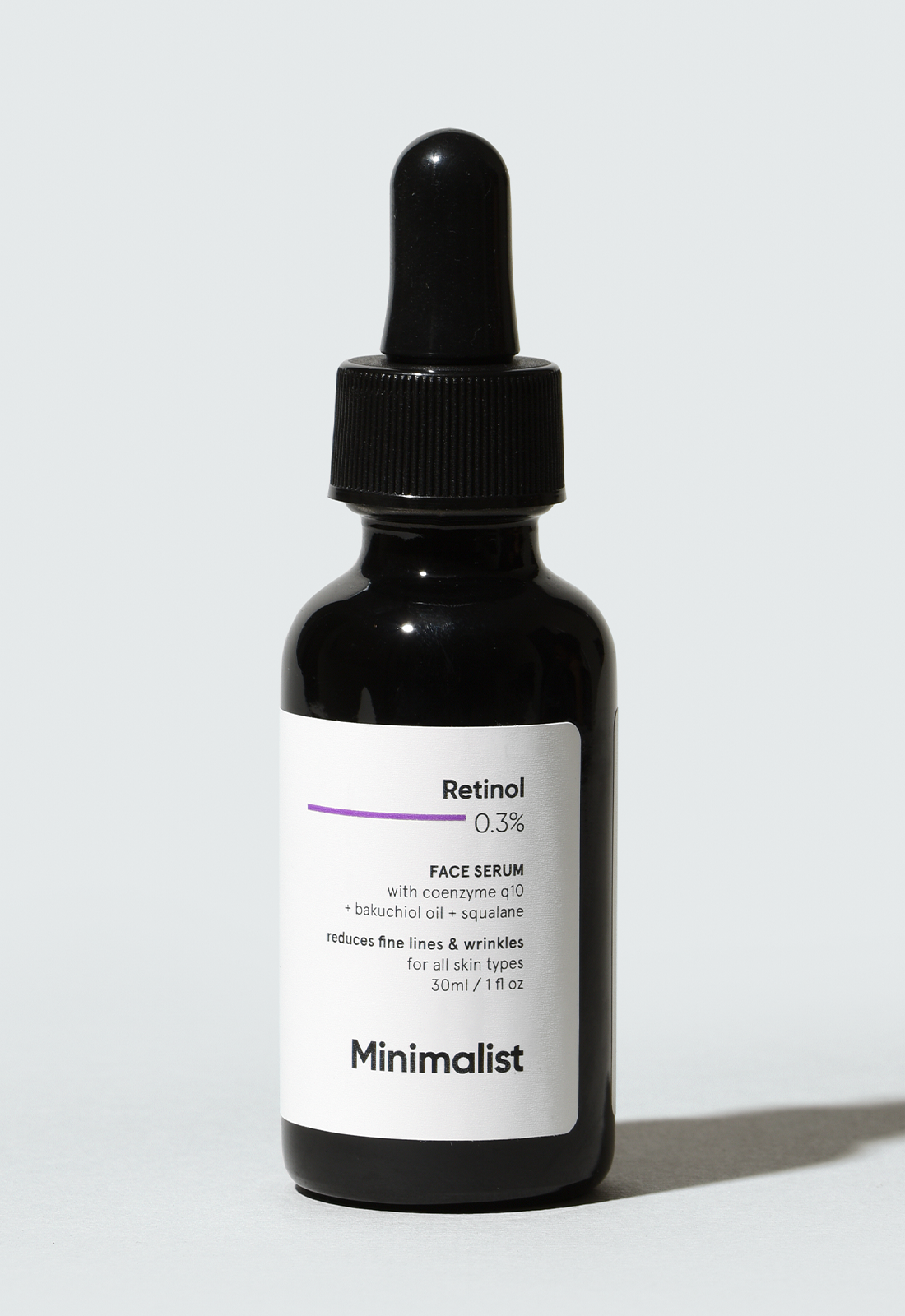
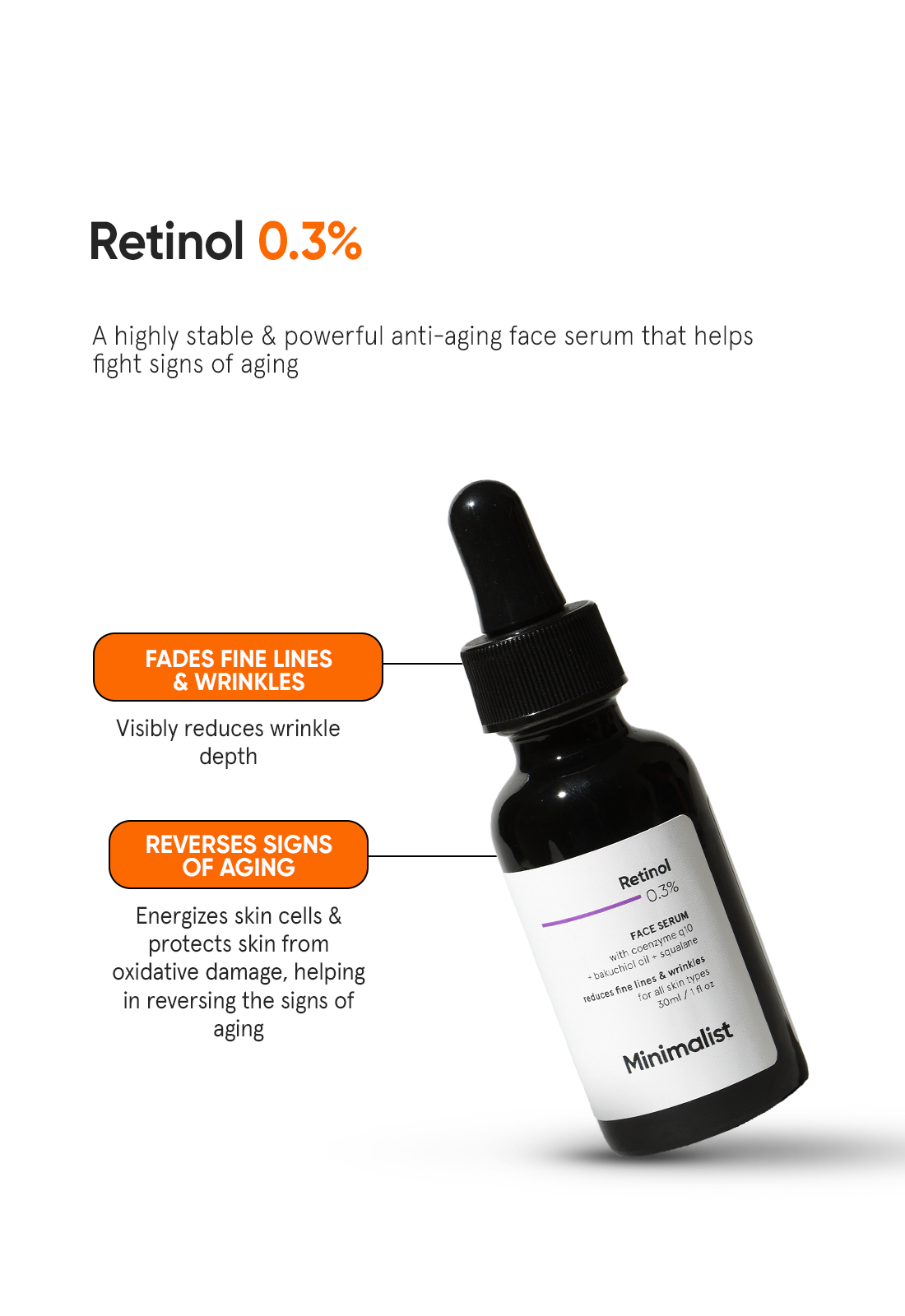
Minimalist Retinol 0.3% + Coenzyme Q10 is a night serum with 0.3% retinol, 1% bakuchiol and CoQ10 in a completely water-free base. That last detail is not a footnote — retinol degrades in water, and an anhydrous formula is how you keep it intact in the bottle.
This page gives you the complete official ingredient list, how retinol actually works inside a skin cell, and the safety rules that genuinely matter with this ingredient.
Table of Contents
- What Minimalist Retinol 0.3% Is
- How Retinol Works Inside the Skin
- The Retinoid Ladder — Where 0.3% Sits
- Why Minimalist Retinol Has No Water In It
- 1% Bakuchiol — Not a Substitute, a Partner
- Coenzyme Q10 and Vitamin E
- Safety Rules That Are Not Optional
- Purging vs Irritation — How to Tell
- The Sandwich Method for Sensitive Skin
- Using Minimalist Retinol in a High-UV Country
- Who Minimalist Retinol Suits
- How to Use Minimalist Retinol 0.3%
- What Not to Layer With It
- A Realistic 12-Week Ramp-Up Schedule
- Why Most People Give Up on Retinol
- Is Minimalist Retinol Worth It?
- What to Expect from Minimalist Retinol
- Storing Minimalist Retinol
- Delivery Across Bangladesh
- Common Questions
- Full Ingredient List
What Minimalist Retinol 0.3% Is
Minimalist Retinol 0.3% + Coenzyme Q10 is a 30 ml oil-based night serum. The official name includes the Q10 because it is a real part of the formula, not a marketing suffix — you may see it listed elsewhere simply as “0.3% Retinol Face Serum”, and it is the same product.
It targets fine lines, uneven texture, enlarged pores and dullness. It is for evening use only, and it is not suitable for anyone pregnant, breastfeeding or under 18.
How Retinol Works Inside the Skin
Retinol is a form of vitamin A, and it is the most thoroughly researched anti-ageing ingredient in cosmetics. Understanding the mechanism explains both why it works and why it takes months.
Retinol itself is not the active form. Once absorbed, skin cells convert it in two steps — retinol becomes retinaldehyde, then retinaldehyde becomes retinoic acid. Only retinoic acid binds the nuclear receptors that change how the cell behaves.
Those changes are real and measurable: faster turnover of surface cells, increased collagen production in the dermis, and normalised keratinisation so pores clog less. That is the whole basis of retinol’s reputation.
The catch is that each conversion step loses potency, and the process is gradual. This is why Minimalist Retinol shows results over months rather than weeks, and why anyone promising a two-week transformation is not describing retinol.
The Retinoid Ladder — Where 0.3% Sits
“Retinoid” covers a family of molecules at very different strengths. Knowing the ladder stops you buying the wrong rung.
| Form | Conversion steps to active | Strength |
|---|---|---|
| Retinyl palmitate | Three | Weakest — often too weak to matter |
| Retinol | Two | The effective over-the-counter standard |
| Retinaldehyde | One | Stronger, faster, more irritating |
| Tretinoin (retinoic acid) | None | Prescription only |
Within retinol itself, 0.3% is the accepted starting concentration — high enough to produce real change, low enough that most people can tolerate it with a sensible ramp-up. 0.5% and 1% exist for people already adapted. Starting at 1% is the most common way to wreck your barrier and quit.
Why Minimalist Retinol Has No Water In It
Read the ingredient list and you will not find Aqua anywhere. The base is caprylic/capric triglyceride, isododecane, squalane, coco-caprylate and triheptanoin — all oils and esters.
This is a deliberate and fairly expensive formulation choice. Retinol degrades in the presence of water, light and oxygen. A water-based retinol serum starts losing potency the day it is made, and by the time it reaches you the number on the bottle may be optimistic.
An anhydrous formula removes the largest of those three problems. Add BHT at the end of the list — an antioxidant included specifically to protect the retinol from oxidation — and you have a formula built for the retinol to still be 0.3% when you actually use it.
The trade-off is texture. Minimalist Retinol feels like an oil, because it is one. It absorbs well thanks to the light esters, but people expecting a water-light serum should know what they are buying.

1% Bakuchiol — Not a Substitute, a Partner
Bakuchiol comes from the seeds of Psoralea corylifolia, and it is usually sold as a “natural retinol alternative”. That framing is half right.
Bakuchiol is not a vitamin A derivative and does not convert to retinoic acid. What the research shows is that it influences some of the same downstream gene expression, producing broadly similar effects on lines and firmness with markedly less irritation.
What is interesting here is that Minimalist Retinol contains both, at 1% bakuchiol. It is not being used as a replacement — it is sitting alongside the retinol, which is the more useful arrangement. Studies pairing the two suggest bakuchiol can improve tolerance while adding its own benefit.
Note its position: bakuchiol appears above retinol on the ingredient list, consistent with 1% against 0.3%.
Coenzyme Q10 and Vitamin E
Ubiquinone (Coenzyme Q10) is an antioxidant your cells produce naturally and produce less of with age. Topically it helps neutralise free radicals, and it pairs sensibly with retinol — retinol drives cell activity, and antioxidants protect that activity from oxidative stress.
Tocopheryl acetate (vitamin E) sits high on the list. It does double duty: an antioxidant for the skin, and protection for the oils and the retinol in the bottle.
Both are supporting cast. The retinol is the reason this product exists.
Safety Rules That Are Not Optional
Retinol is effective, which means it needs respecting. Four rules, and none of them are negotiable.
- Not during pregnancy or breastfeeding. Oral retinoids are known teratogens, and while topical absorption is low, the medical consensus is to avoid vitamin A derivatives entirely during pregnancy. The brand states this directly. If you are pregnant, trying, or breastfeeding, do not use Minimalist Retinol — talk to your doctor about alternatives.
- Not under 18. The brand restricts it, and there is no good reason for teenage skin to be on retinol without a dermatologist involved.
- Night only. Retinol is degraded by light and increases sun sensitivity. Morning use wastes the product and raises your risk.
- Daily sunscreen, without exception. Retinol thins the outermost layer while it works. Using it without SPF is actively worse than using neither.
This is product information, not medical advice. If you have a skin condition, are on prescription treatment, or are unsure, ask a dermatologist before starting.

Purging vs Irritation — How to Tell
Weeks two and three are when most people quit, usually because they cannot tell these apart.
Purging looks like small spots appearing faster than usual, in the places you normally break out. It happens because retinol accelerates turnover, bringing existing congestion to the surface sooner. It is temporary and it settles by around week six. The brand flags a two-to-three week purge as expected.
Irritation looks different: burning, persistent redness, flaking in sheets, tightness, or spots appearing in places you never break out. That is your barrier objecting, and pushing through it makes things worse — inflammation causes pigmentation, which on Bangladeshi skin tones is the opposite of what you wanted.
If it is irritation: stop for a week, repair with a plain moisturiser, then restart at two nights a week.
The Sandwich Method for Sensitive Skin
If your skin is reactive, do not start Minimalist Retinol neat on bare skin. Use the sandwich.
Apply a thin layer of plain moisturiser, wait a few minutes, apply Minimalist Retinol, then moisturiser again on top. The buffering layers slow absorption, which lowers irritation substantially while keeping most of the benefit.
It is not cheating and it is not wasting the product. For a lot of people it is the difference between using retinol for years and abandoning it in month one.
Using Minimalist Retinol in a High-UV Country
Two things make retinol harder to run well in Bangladesh than in the markets these products are written for.
UV load. The index runs high most of the year. Retinol temporarily thins the stratum corneum and raises photosensitivity, so the sunscreen requirement is heavier here, not lighter. If you are not already wearing SPF every day without fail, fix that habit first and start retinol a month later.
Pigment response. Fitzpatrick IV–V skin responds to irritation with pigment. Retinol irritation on deeper skin tones does not just look red for a week — it can leave a brown mark that outlasts the irritation by months. This is the strongest possible argument for starting slowly with Minimalist Retinol rather than pushing through discomfort.
Pair it properly from our sunscreen range, and keep a barrier cream on hand.
Who Minimalist Retinol Suits
Good for adults over 18 concerned with early fine lines, uneven texture, visible pores or dullness. Good for acne-prone skin, since retinol normalises how pores shed. Good as a first retinol, because 0.3% is the right rung to start on and the bakuchiol softens the landing.
Not for you if you are pregnant, trying to conceive or breastfeeding. Not for under-18s. Not if your barrier is currently damaged — repair first with something like the Purito Mighty Bamboo Panthenol Cream, then start. Not if you will not wear sunscreen daily.
How to Use Minimalist Retinol 0.3%
- Evening only. Cleanse and let skin dry fully — damp skin increases absorption and irritation.
- Apply any water-based serums first, then Minimalist Retinol, then moisturiser. The brand specifies this order.
- Weeks 1–2: alternate nights. Then build to daily if your skin is comfortable.
- A few drops is enough for the whole face. More does not work faster.
- Avoid the immediate eye area, the corners of the nose and any broken skin.
- Sunscreen every morning, without exception.
- Patch test first if your skin is hypersensitive.
What Not to Layer With It
Do not use on the same night as: AHA or BHA exfoliants, benzoyl peroxide, or a scrub. Stacking these with Minimalist Retinol is the fastest route to a damaged barrier.
Fine to combine: niacinamide, hyaluronic acid, ceramides, peptides, panthenol. These support the barrier while retinol works, which is exactly what you want.
Vitamin C: keep it in the morning. There is no chemical catastrophe if you use both at night, but splitting them is easier on the skin and neither loses anything.
Azelaic acid: generally compatible, and often combined by dermatologists. Alternate nights if you are sensitive.
A Realistic 12-Week Ramp-Up Schedule
Most retinol failures are scheduling failures, not product failures. Here is a conservative plan for Minimalist Retinol that works for the majority of skin.
| Weeks | Frequency | What you are doing |
|---|---|---|
| 1–2 | Two nights a week | Finding out whether your skin objects at all |
| 3–4 | Alternate nights | The brand’s stated pace, once you know you tolerate it |
| 5–8 | Five nights a week | Through the purge window, holding steady |
| 9–12 | Nightly | Full use, if and only if your skin is comfortable |
If any step brings stinging or flaking, drop back one row for two weeks rather than pushing on. Nobody wins a race against their own barrier, and there is no benefit to reaching nightly use in month one instead of month three.
Why Most People Give Up on Retinol
Three patterns account for nearly every abandoned bottle, and all three are avoidable.
Starting too strong, too fast. Nightly from day one, often at a higher percentage than 0.3%. The skin protests within a fortnight and the product goes in a drawer.
Quitting during the purge. Weeks two and three look like the product is causing breakouts. It is surfacing congestion that was already there. Six weeks is the earliest fair judgement.
Expecting the wrong outcome. Minimalist Retinol is not a spot treatment and not an overnight glow product. It is a long, quiet investment in texture and collagen. People who understand that stay with it; people expecting week-two results do not.
Is Minimalist Retinol Worth It?
A 30 ml bottle used a few drops at a time, ramping to nightly, runs three to four months. Judged per night, it is inexpensive for the single best-evidenced anti-ageing active available without a prescription.
The honest condition attached: it is worth it only if you will also wear sunscreen daily and give it three months. Without the sunscreen you are working against yourself. Without the patience you will never see what you paid for. Buy Minimalist Retinol if you are ready for both.
What to Expect from Minimalist Retinol
| Timeframe | What you should notice |
|---|---|
| Week 1–2 | Possible mild dryness or flaking as skin adapts. This is retinisation, not failure |
| Week 2–3 | Possible purge — spots surfacing faster in your usual areas |
| Week 6–8 | Texture smoother, skin looks brighter, fewer new congestion spots |
| Month 3–6 | Fine lines soften; pores look less prominent. This is where retinol earns its reputation |
| Month 6+ | Collagen changes are slow and cumulative — the benefit keeps building with continued use |
Two honest caveats. Retinol does not fill deep static wrinkles or lift sagging — those need clinical treatment. And every gain reverses if you stop; retinol maintains, it does not cure.
Storing Minimalist Retinol
Keep it capped, upright, away from light and heat. Retinol is degraded by all three. The opaque bottle helps, but a serum stored on a sunny shelf through a Dhaka summer will lose potency well before its printed date.
Follow the expiry and period-after-opening symbol. Use it within the stated window — an old retinol serum is not dangerous, it is simply weaker than you think, which is its own kind of waste.
Delivery Across Bangladesh
| Area | Delivery charge |
|---|---|
| Dhaka city | ৳120 |
| Munshiganj | ৳120 |
| Outside Dhaka | ৳150 |
Cash on delivery available nationwide. Every product we stock is authentic, sourced through trusted suppliers and established distribution channels, with packaging and condition checked before dispatch.
Common Questions
Is 0.3% strong enough to do anything?
Yes. 0.3% retinol is a clinically meaningful concentration and the standard starting strength. Higher is not better if your skin cannot tolerate it.
Can I use Minimalist Retinol while pregnant?
No. The brand excludes pregnant and breastfeeding users, and that reflects standard medical advice on topical vitamin A. Speak to your doctor about alternatives.
Why is there no water in it?
Retinol degrades in water. The anhydrous base plus BHT keeps the 0.3% intact until you use it.
Is bakuchiol here instead of retinol?
No — both are present. The bakuchiol supplements the retinol and improves tolerance rather than replacing it.
Will Minimalist Retinol make me purge?
Possibly, for two to three weeks. Spots in your usual areas that settle by week six are purging. Burning, sheet-like flaking or spots in new areas are irritation — stop and restart slower.
Morning or night?
Night only, always, and sunscreen every morning.
10 ml or 30 ml?
Minimalist make both. This listing is the 30 ml bottle.
Full Ingredient List
The full ingredient list for Minimalist Retinol 0.3% + Coenzyme Q10, reproduced from the official Minimalist product page:
Caprylic/Capric Triglyceride, Isododecane, Squalane, Coco-Caprylate/Caprate, Triheptanoin, Tocopheryl Acetate, Bakuchiol, Retinol, Polysorbate 20, Ubiquinone (Coenzyme Q10), BHT
Always read the ingredient list printed on the carton you receive. If you have a known allergy to any ingredient, check before use. This page is product information, not medical advice.
Reviews
There are no reviews yet.