Description
What the Medicube PDRN Pink Peptide Serum is
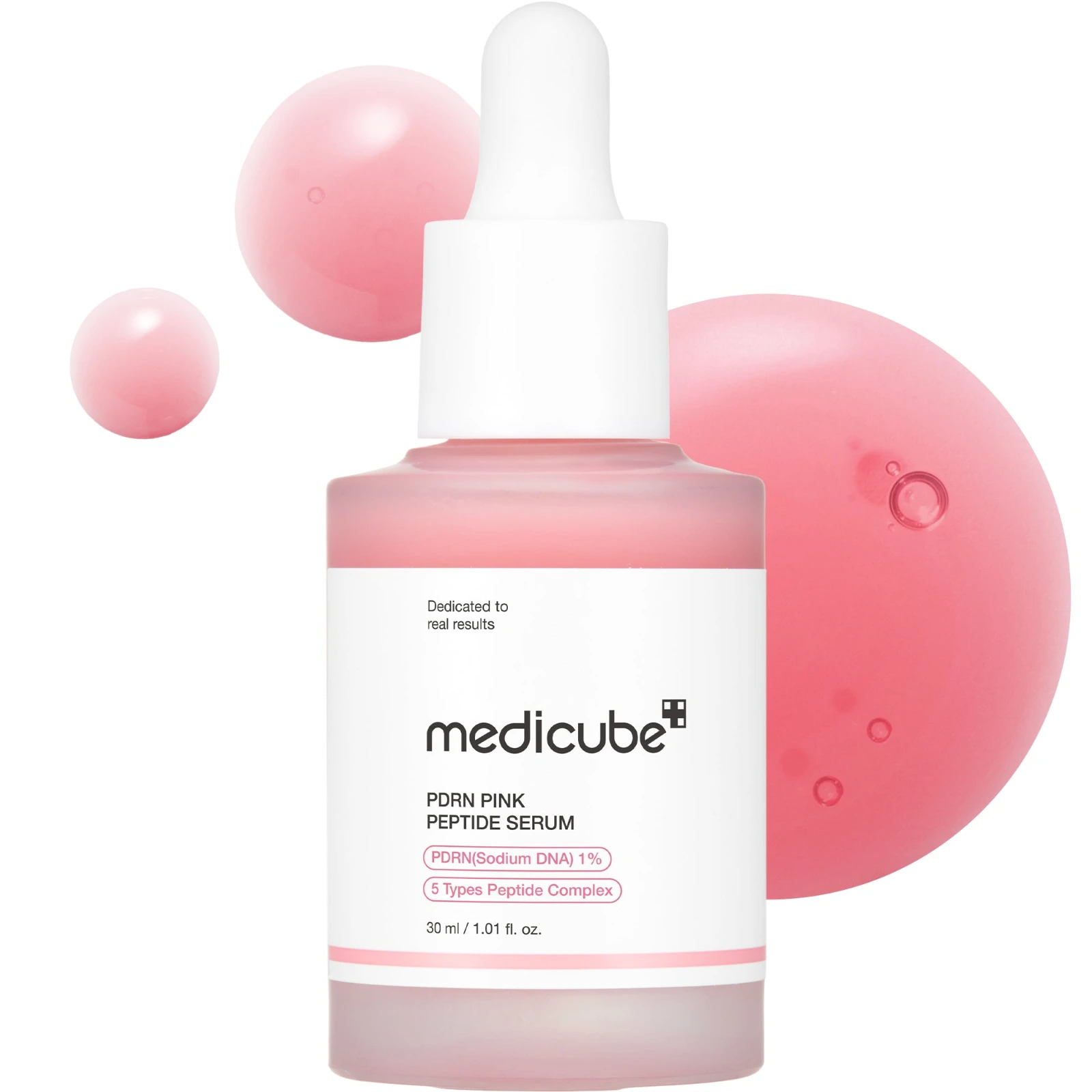
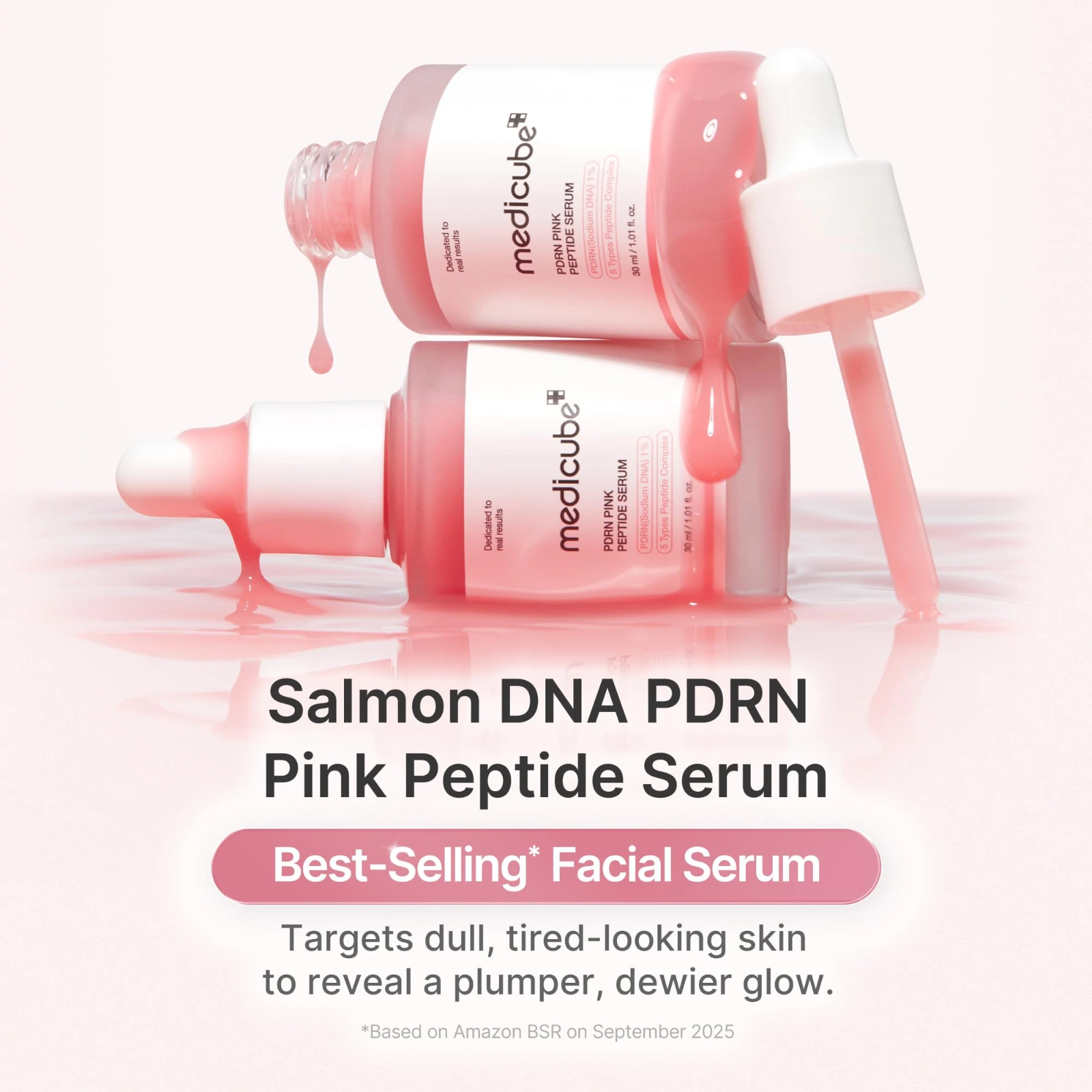
The Medicube PDRN Pink Peptide Serum is a 30 ml pink dropper serum aimed at dullness, uneven tone and loss of firmness. It is the product that put Medicube’s PDRN line on shelves worldwide, and it is the one most people mean when they say they want “the pink Medicube serum”.
Forty ingredients. Made in Korea. And it contains ingredients that a good number of our customers will want to know about before they buy, which is where this page starts rather than ends.
Where the Medicube PDRN Pink Peptide Serum PDRN comes from — please read this part
PDRN stands for polydeoxyribonucleotide. It is a fragment of DNA, and in this serum it comes from fish.
The ingredient list contains three salmon-derived entries:
- Milt extract, fourteenth. Milt is fish seminal fluid. It is the standard commercial source of PDRN and it is what most salmon-PDRN products in the world are built on.
- Salmon egg extract, thirty-ninth.
- Atelocollagen, fortieth — collagen of animal origin.
Plus hydrolyzed collagen at thirtieth, also animal-derived, and sodium DNA at eighth, which is the PDRN itself.
We are stating this plainly because most sellers in this market do not. If animal-derived ingredients matter to you — for religious reasons, dietary ones, or simply because you would rather know — the Medicube PDRN Pink Peptide Serum contains them, and they are not hidden at the bottom of the list in trace amounts. Milt extract is fourteenth of forty.
None of this is a safety issue. Salmon PDRN is well studied and widely used. It is a disclosure issue, and you deserve the disclosure before you spend two thousand taka rather than after.
There is a vegan Medicube PDRN Pink Peptide Serum, and it is not the same formula
Medicube also makes a Rose PDRN version of this serum for people who want to avoid the fish. It is worth knowing what changes, because the marketing presents them as equivalent and the ingredient lists say otherwise.
In the rose version, the milt extract, salmon egg extract, atelocollagen and hydrolyzed collagen are all gone, replaced by Rosa damascena extract. Good so far. But the sodium DNA — the actual PDRN — moves from position eight down to position thirty.
That is a large drop. The vegan version is not the same product with the fish swapped out; it is a substantially lighter formula on the ingredient the line is named after.
Check your box before you buy anywhere. The version we stock is the salmon one, which is what Medicube sells as standard in Korea. If a seller is not telling you which one they have, ask.
The Medicube PDRN Pink Peptide Serum ingredient list — all forty
Transcribed from Medicube’s Korean legal filing and cross-checked against their English list. The two match.
Water, Glycerin, Dipropylene Glycol, Isopropyl Myristate, Glycereth-26, Niacinamide, 1,2-Hexanediol, Sodium DNA, Butylene Glycol, Polyglycerin-3, Sodium Acrylate/Sodium Acryloyldimethyl Taurate Copolymer, Polyisobutene, Acrylates/C10-30 Alkyl Acrylate Crosspolymer, Milt Extract.
Tromethamine, Glyceryl Acrylate/Acrylic Acid Copolymer, PVM/MA Copolymer, Ethylhexylglycerin, Caprylyl Glycol, Fragrance, Melia Azadirachta Leaf Extract, Adenosine, Caprylyl/Capryl Glucoside, Sorbitan Oleate, Melia Azadirachta Flower Extract, Sodium Hyaluronate, Disodium EDTA, Curcuma Longa (Turmeric) Root Extract.
Cyanocobalamin, Hydrolyzed Collagen, Ubiquinone, Ocimum Sanctum Leaf Extract, Corallina Officinalis Extract, Palmitoyl Pentapeptide-4, Palmitoyl Tripeptide-1, Palmitoyl Tetrapeptide-7, Copper Tripeptide-1, Acetyl Hexapeptide-8, Salmon Egg Extract, Atelocollagen.
What is genuinely working in the Medicube PDRN Pink Peptide Serum
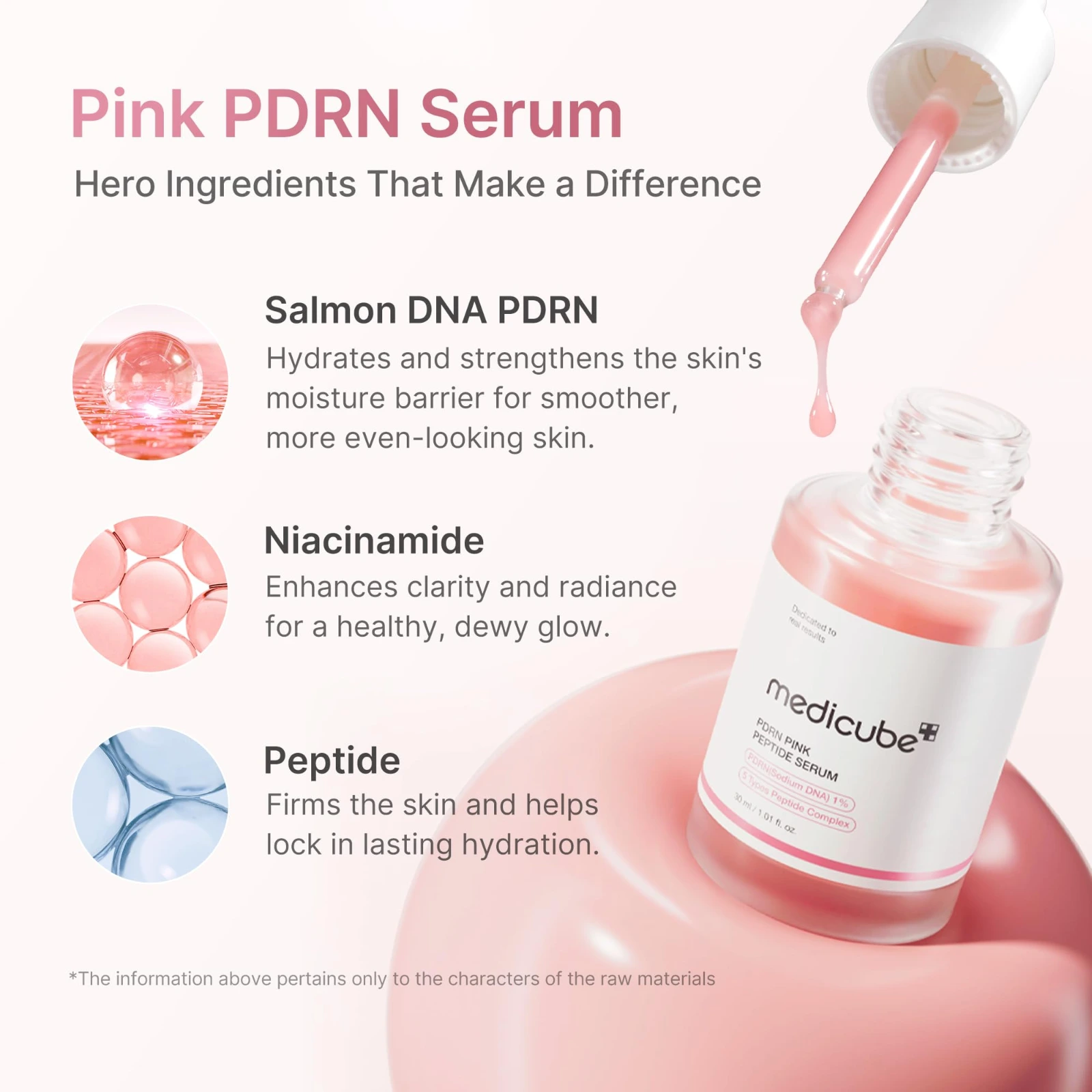
Sodium DNA, eighth
The PDRN itself, and eighth of forty is a respectable position — above almost everything except water and solvents. Whatever you think of the evidence for topical PDRN, Medicube has not put it at the bottom of the list. That is more than we could say for most of the products we have listed this month.
Niacinamide, sixth
Higher than the PDRN. This is the ingredient most likely to deliver the tone and clarity results the serum is sold on, and it is well evidenced. If the Medicube PDRN Pink Peptide Serum works for your uneven tone, niacinamide is the likeliest reason.
Five Medicube PDRN Pink Peptide Serum peptides, positions thirty-four to thirty-eight
Palmitoyl pentapeptide-4, palmitoyl tripeptide-1, palmitoyl tetrapeptide-7, copper tripeptide-1 and acetyl hexapeptide-8. Five real, named, well-researched peptides — and all five in the last seven slots of the formula.
The count is honest. The placement is not flattering. Peptides work at measurable concentrations and nothing at position thirty-eight of forty is at a measurable concentration. Buy this for the sodium DNA and the niacinamide; treat the peptide list as a label feature.
Adenosine, twenty-second
Korea’s approved anti-wrinkle functional ingredient, present but low.
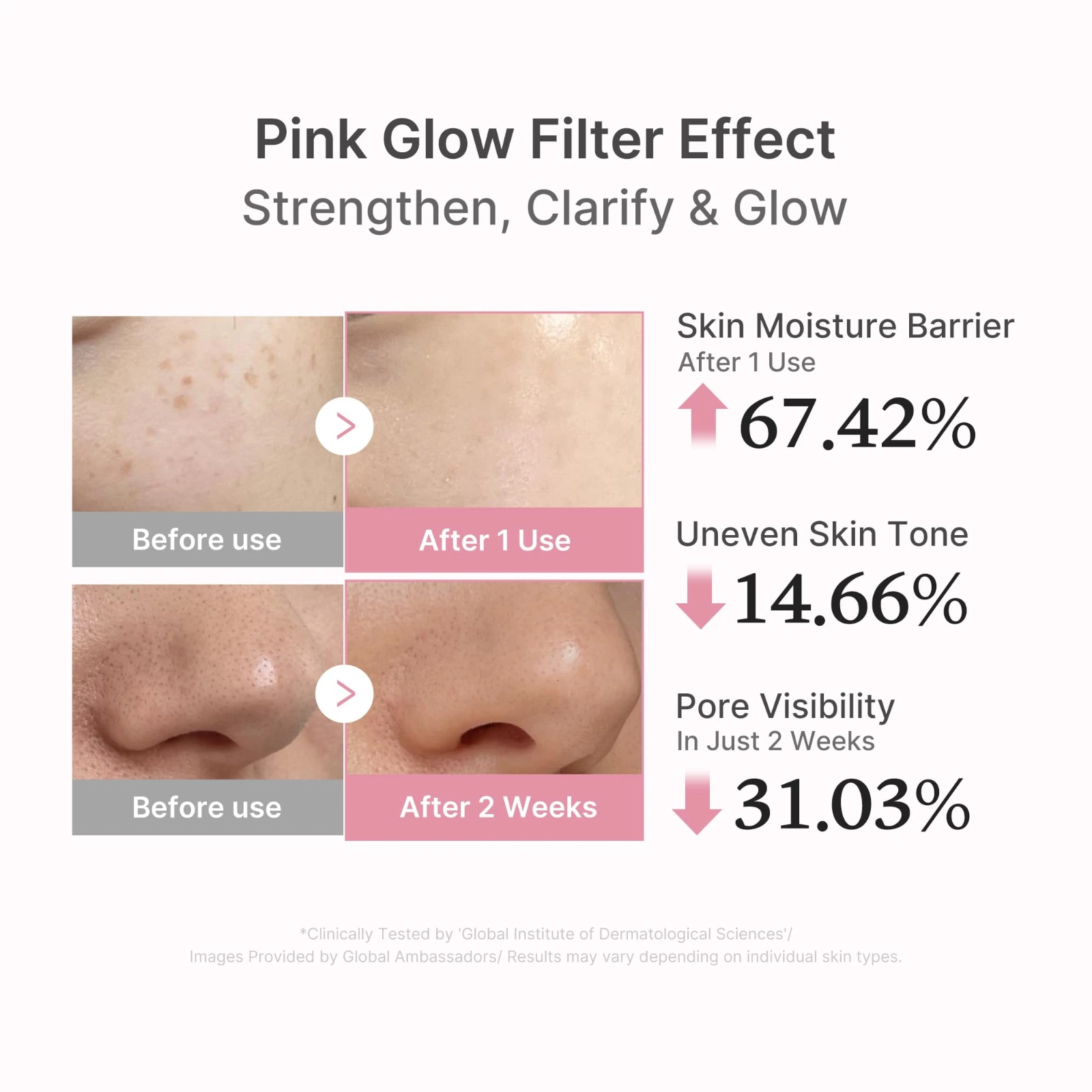
The Medicube PDRN Pink Peptide Serum numbers, and the footnote underneath them
Medicube publishes three figures with before-and-after photographs.
- Skin moisture barrier up 67.42 percent — after one use
- Uneven skin tone down 14.66 percent
- Pore visibility down 31.03 percent in two weeks
Two things to notice. The barrier figure is measured after a single application, which is a category-wide habit and means very little — apply any humectant serum and your barrier readings jump for a few hours.
The second is the footnote, printed in grey type below the images. It says the results were clinically tested by the Global Institute of Dermatological Sciences, and then, separately: “Images Provided by Global Ambassadors.”
Read that again. The numbers came from an institute. The dramatic before-and-after photographs printed beside them came from brand ambassadors — people paid to promote the product. Those are two different sources of evidence presented as one, and the only thing telling you so is a line of small grey text.
We would still call the two-week pore figure worth having. We would not look at those photographs and expect that face.
A separate Medicube PDRN Pink Peptide Serum firmness claim
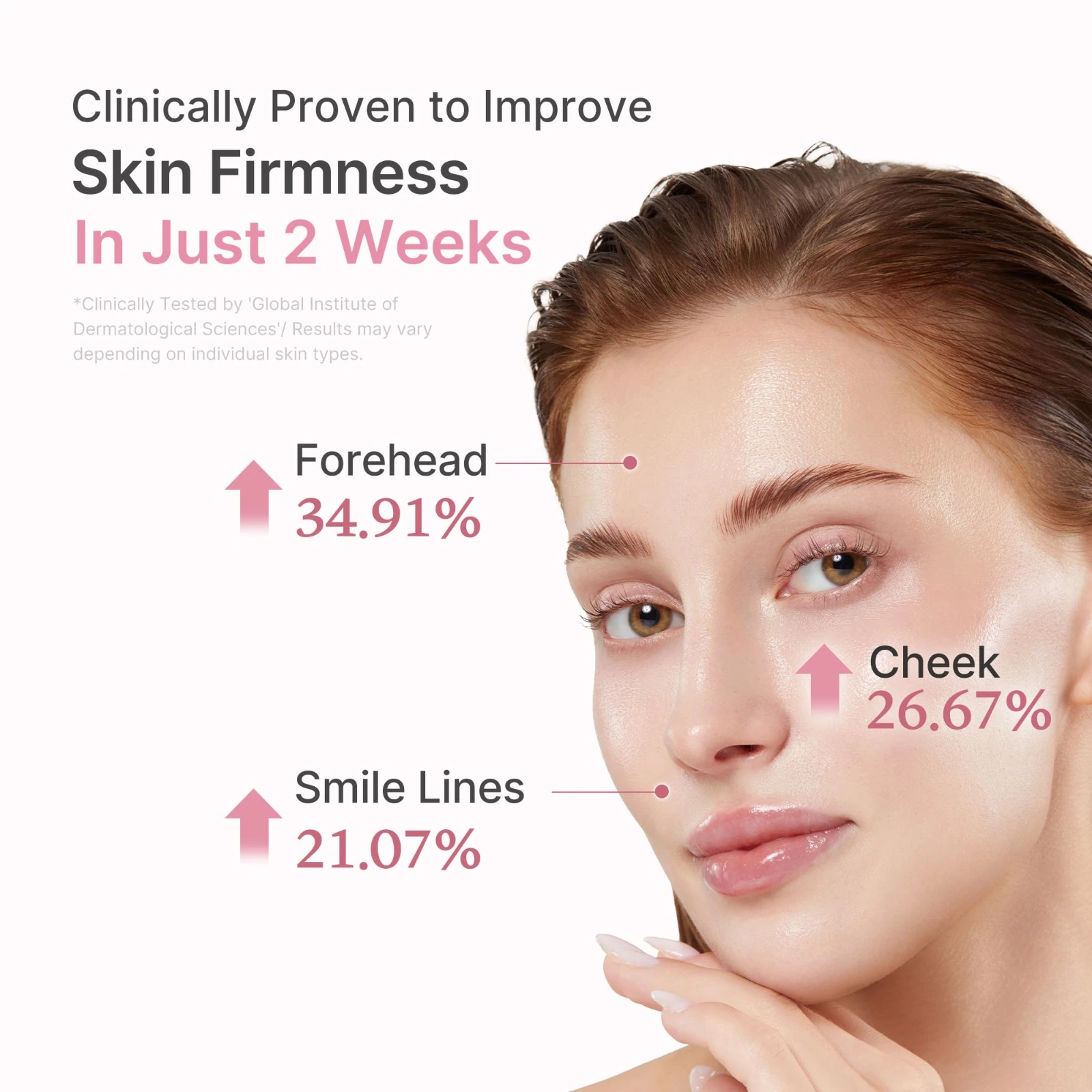
Medicube publishes a second set: firmness improved 34.91 percent on the forehead, 26.67 percent on the cheek and 21.07 percent on smile lines, in two weeks.
Those are large numbers for two weeks and no participant count is given. Firmness is also one of the harder things to measure objectively. We report the figures because Medicube published them; we would not build your expectations on them.
“No artificial fragrance” — but fragrance is in the list
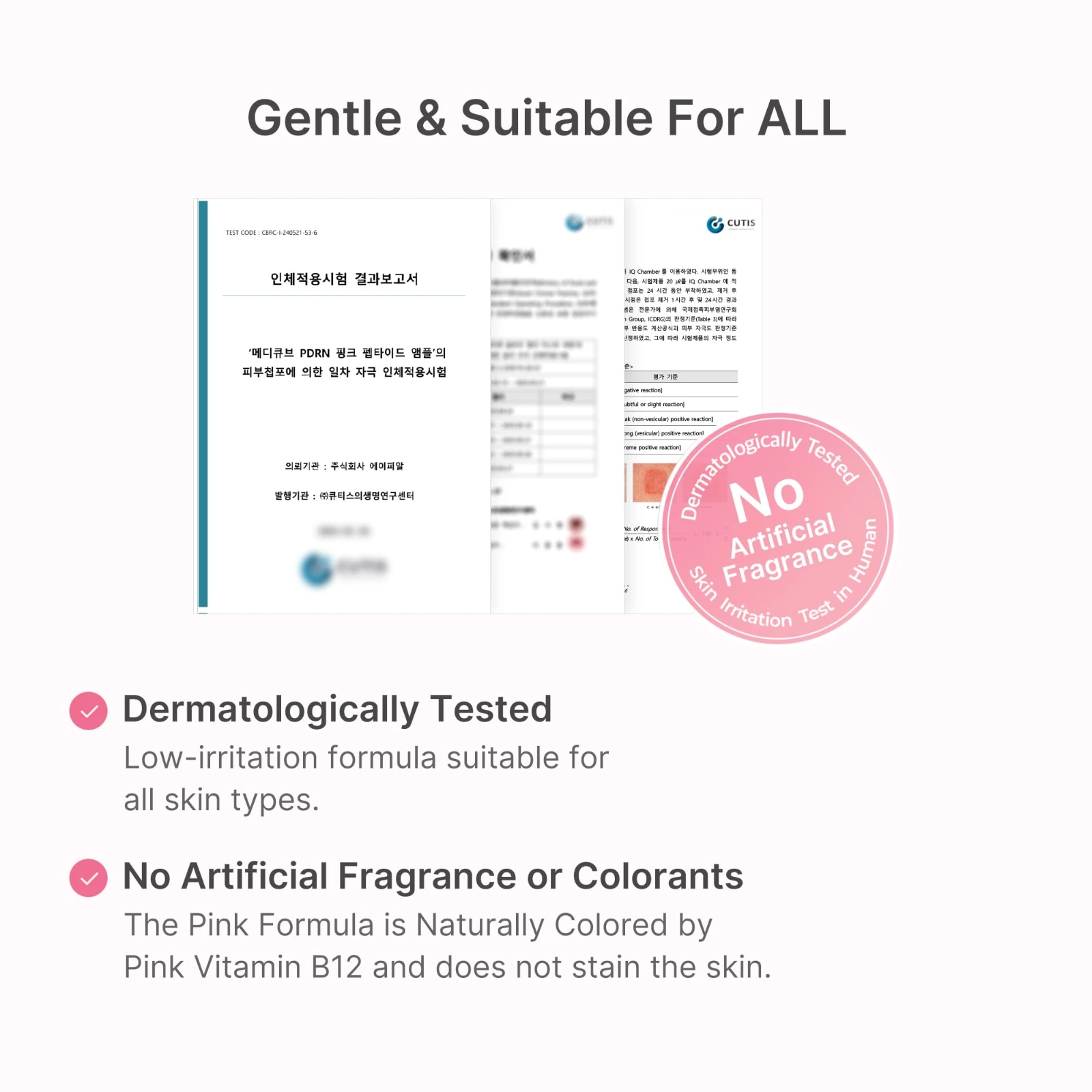
One of Medicube’s panels states “No Artificial Fragrance or Colorants.”
The colorant half is true and rather charming: there is no CI pigment anywhere in the forty ingredients, and the pink comes from cyanocobalamin — vitamin B12 — at position twenty-nine. B12 is naturally deep pink. That claim checks out completely.
The fragrance half is harder. Fragrance is declared at position twenty of the ingredient list. Whether it is “artificial” is not something the INCI tells you, and Medicube has not published what is in it. So the claim is not disprovable, but it is also not verifiable, and a shopper reading “no artificial fragrance” would reasonably conclude there is no fragrance at all. There is.
If you are avoiding fragrance, the Medicube PDRN Pink Peptide Serum is not the serum for you, whatever the panel says.
On the Medicube PDRN Pink Peptide Serum functional certification
Medicube’s American page describes this serum as having “dual functionality for fine lines and brightening” attributed to South Korea’s Ministry of Food and Drug Safety.
The Korean product listing for the same ampoule records 기능성화장품: 무 — no functional cosmetic designation. We could not reconcile the two, and we are not going to repeat a regulatory claim we cannot verify. Compare this with our Arencia Holy Hyssop Serum, where the dual certification is recorded on the Korean listing and we do repeat it.
What PDRN is, and what the Medicube PDRN Pink Peptide Serum evidence supports
PDRN has become the most hyped ingredient in Korean skincare and it is worth separating what is established from what is being sold.
The established part is clinical. PDRN injected into skin has real published evidence behind it for wound healing and tissue repair, which is why it appears in dermatology clinics. That research is where the ingredient’s reputation comes from, and it is genuine.
The part that does not transfer is the route. Injected PDRN is placed under the skin. The PDRN in the Medicube PDRN Pink Peptide Serum is applied on top of it, and DNA fragments are large molecules — the same size problem that makes topical collagen a marketing ingredient rather than a working one.
Does that mean it does nothing? Not necessarily. Sodium DNA is a decent humectant and there is early work on smaller fragments penetrating better. But the clinic studies people cite when they recommend PDRN serums were not done with serums, and anyone telling you a bottle does what an injection does is selling rather than explaining.
Our honest position on the Medicube PDRN Pink Peptide Serum: buy it as a well-built niacinamide serum with a good humectant system and a pleasant texture. If the PDRN adds something on top, that is a bonus rather than the purchase.
How to use the Medicube PDRN Pink Peptide Serum
- Cleanse, then apply toner or essence.
- Dispense two to three drops onto clean, dry skin.
- Spread evenly over face and neck and pat until absorbed.
- Follow with moisturiser, and sunscreen in the morning.
Medicube recommends it morning and night, and the formula is mild enough for that. There is no acid, no retinoid and no exfoliant in it, so it does not need building up the way our kojic acid or LHA products do.
It is not a heavy serum but it does contain isopropyl myristate at position four, which is a lightweight ester some acne-prone skin dislikes. If you break out easily, patch test along the jaw for a week.
Layering the Medicube PDRN Pink Peptide Serum with other actives
This is one of the easier serums to layer. Niacinamide, sodium DNA, peptides and hyaluronic acid all play nicely with almost everything.
It sits comfortably before or after most treatments, over a toner and under a moisturiser. With retinoids it is fine on the same night — in fact a barrier-supporting serum alongside a retinoid is a sensible combination. With strong acids, apply this after the acid has absorbed rather than mixing them.
Do not layer it with another niacinamide serum. Ours include the Medicube Kojic Acid Turmeric Serum and two Arencia serums — pick one for the step and give it three months.
Medicube PDRN Pink Peptide Serum or Ultra Light — which to buy
Medicube makes two versions of this and we stock both, so here is the difference in plain terms.
This one is the original: richer, slightly more emollient, and the one to pick for normal, dry or mature skin, or for use at night. The Ultra Light version is a thinner, faster-absorbing reformulation aimed at oily and combination skin and at daytime use under sunscreen.
The Ultra Light also costs meaningfully less at our prices. If you have oily skin and Dhaka humidity to contend with, start there rather than here — it is the better match and the cheaper one, and we would rather say so.
How the Medicube PDRN Pink Peptide Serum suits this climate
Reasonably, with a caveat. It is a humectant-led serum built on glycerin, sodium hyaluronate and sodium DNA, all of which draw water. In Dhaka’s humidity that works in your favour for most of the year — there is moisture in the air for them to pull from.
The caveat is texture. This is the richer of the two versions, and in June and July oily skin may find it sits heavily under sunscreen. That is exactly what the Ultra Light exists for.
Store it out of direct sun. Vitamin B12 is what makes it pink and B12 is light-sensitive — a bottle left on a bright windowsill will fade, which tells you the formula has been sitting in conditions it should not have been.
Who the Medicube PDRN Pink Peptide Serum suits
Good fit: dullness, uneven tone, early loss of firmness, dehydrated skin, normal to dry skin, and anyone wanting a gentle daily serum that will not clash with the rest of their routine.
Poor fit: anyone avoiding animal-derived ingredients, anyone avoiding fragrance, very oily skin in high summer, and anyone expecting the results in the ambassador photographs.
Not suitable if you have a fish or shellfish allergy. Milt extract, salmon egg extract and atelocollagen are all fish-derived and milt sits fourteenth. Ask your doctor if you are unsure — this is one of the few products we sell where an allergy question has a clear answer and it is worth asking.
What 30 ml of the Medicube PDRN Pink Peptide Serum works out to per use
Two to three drops is roughly 0.3 ml, so a 30 ml bottle gives around a hundred applications — about three months used once daily, or six weeks morning and night.
That puts the Medicube PDRN Pink Peptide Serum at a little under twenty taka per use. For a niacinamide and PDRN serum with five peptides on the label it is fair. Against the Ultra Light at our pricing it is the more expensive of the pair, which is worth weighing if your skin would be happier with the lighter one anyway.
Questions we get asked
Is the PDRN in the Medicube PDRN Pink Peptide Serum really from salmon sperm?
Milt is fish seminal fluid, and yes, it is the standard commercial source of PDRN. It is processed, purified and standardised — what ends up in the bottle is a DNA fragment, not the raw material. But the origin is what it is, and you are entitled to know it before you buy.
Is the Medicube PDRN Pink Peptide Serum halal?
We cannot tell you that. Medicube holds no halal certification we can verify, and fish-derived ingredients raise questions that differ between schools of thought. What we can do is tell you exactly what is in it — milt extract, salmon egg extract and atelocollagen — and let you take that to someone qualified to advise you.
Is the Medicube PDRN Pink Peptide Serum vegan?
No. This version contains four animal-derived ingredients. Medicube’s Rose PDRN version is the vegan one, and we do not currently stock it.
Will the Medicube PDRN Pink Peptide Serum stain my skin pink?
No. The colour is vitamin B12 and Medicube states it does not stain. It absorbs clear.
Does the Medicube PDRN Pink Peptide Serum contain fragrance?
Yes, at position twenty. Medicube’s panel says “no artificial fragrance”, which is a narrower claim than it appears.
How long before the Medicube PDRN Pink Peptide Serum does anything?
Medicube says two weeks. We would say give it two to three months for tone, and be sceptical of any firmness claim you cannot measure. Take a photograph in consistent light on day one.
Is the Medicube PDRN Pink Peptide Serum safe in pregnancy?
There is no retinoid, no salicylic acid and no high-strength acid in it. Ask your doctor rather than a shop, as always.
How we store and ship the Medicube PDRN Pink Peptide Serum
Stock sits in air-conditioned storage in Dhaka until it goes out. Heat and light both matter here — B12 fades and peptides degrade warm.
Your bottle is sealed when it leaves us and it is stock we imported ourselves, not a unit bought from another local seller and passed on. If it arrives unsealed, leaking or noticeably pale, raise it with us the day it lands and we will replace it.
Where the Medicube PDRN Pink Peptide Serum fits in your routine
Cleanse, toner or essence, this, moisturiser, sunscreen in the morning. One step, a few drops, in the middle.
If you are starting from nothing, sunscreen and a cleanser come first. A booster serum is a third or fourth purchase, not a first one.
Buying the Medicube PDRN Pink Peptide Serum in Bangladesh
Sealed 30 ml bottle, imported by us, in stock in Dhaka with nationwide delivery. Every ingredient on this page is transcribed from Medicube’s Korean legal filing and cross-checked against their English list, and you can verify any ingredient name against the EU CosIng database yourself.
Compare it against our other serums, or see everything we stock from Medicube.
Reviews
There are no reviews yet.